01 / The client
About ShipEase: a logistics technology company for eCommerce
ShipEase is a logistics technology (LogTech) company focused on the eCommerce supply chain. Its business model is B2B logistics aggregation and management: it sits between eCommerce platforms, logistics providers and end customers, and aims to make shipping simpler through technology, efficiency and reliability.
ShipEase engaged Ackrolix Innovations to build a multi-sided platform that could serve online retailers, courier partners and developers at the same time, while giving the people waiting for parcels a clear delivery experience. Ackrolix delivered the platform as a progressive web application built with React and Next.js.
- Industry: Logistics Technology (LogTech) and eCommerce solutions.
- Business model: B2B logistics aggregation and management.
- Audiences served: eCommerce retailers, logistics partners, developers, enterprise clients and end customers.
- Industry
- Travel & Transportation, E-commerce & On-Demand
- Services / expertise
- Logistics Software Development · Shipment Tracking Platform · Multi-Carrier Shipping
- Business model
- B2B logistics aggregation and management
- Platforms
- Progressive web app: public website, retailer dashboard, logistics partner portal, developer platform and APIs
- Team size
- 18 professionals
- Duration
- 9 months
02 / The project
What did ShipEase need from a multi-carrier logistics platform?
The requirement covered six areas. Each stakeholder group needed its own tools, but all of them had to work from the same shipment data so that an order could move from booking to delivery, or back as a return, without manual hand-offs between systems.
Public website and brand platform
The marketing site had to explain the value of a unified logistics platform to several audiences at once without blurring the message, and to build credibility in a competitive aggregation market.
- Multi-audience messaging for retailers, logistics partners, developers and enterprise clients.
- A showcase of shipping, tracking, fulfillment and returns capabilities.
- Display of integrated courier partners and coverage areas, including an interactive coverage map.
- A preview of the developer portal, API capabilities and integration options.
Retailer and seller platform
Sellers needed one place to price, book, track and return shipments across carriers.
- Real-time multi-carrier rate comparison.
- Automated shipping label generation with carrier selection.
- A single tracking dashboard across all courier partners.
- Order import from multiple eCommerce platforms and marketplaces.
- Bulk processing for hundreds of orders, returns workflows with automated return labels, and analytics on performance and cost.
Logistics partner portal
Courier partners needed to receive work, coordinate pickups and get paid.
- An order assignment dashboard and pickup scheduling with retailers.
- Real-time delivery status updates and proof-of-delivery capture.
- Performance analytics covering delivery success, on-time percentage and customer ratings.
- Automated invoicing, payment tracking and reconciliation.
Developer platform and API
ShipEase wanted developers to integrate shipping into their own systems.
- RESTful API documentation and an API sandbox.
- Webhooks for shipment status changes.
- SDK libraries plus dedicated rate calculator and tracking APIs.
End customer experience
Buyers needed visibility and some control over their deliveries.
- Customer-facing live tracking pages.
- SMS and email alerts at key milestones.
- Delivery time-window and location preferences.
- Helpdesk integration for delivery queries.
Platform requirements
The platform also had to be installable, fast on mobile and resilient during peak sales periods.
- Progressive web app with no app store installation required.
- Mobile-first design and offline capability for delivery agents.
- WebSocket-based real-time updates.
- Scalability for sales events and festive seasons.
- Integration with Shopify, WooCommerce, Magento, Amazon and Flipkart.
03 / The project
Challenges of building a multi-sided logistics platform
Most of the difficulty came from coordinating parties that do not share systems. Courier partners expose different APIs, retailers run different storefronts, and every status change has to reach all of them quickly and consistently.
Multi-sided platform complexity
Retailers, logistics partners, developers and end customers have very different needs, yet they had to be served on one platform.
- Orchestrating order placement, carrier selection, pickup, transit, delivery and returns across multiple parties.
- Communicating distinct benefits to each stakeholder without confusing the message.
Logistics and operations
Carrier data was inconsistent by nature.
- Courier APIs varied in data format, update frequency and reliability.
- Rate comparison had to account for weight, dimensions, origin, destination and service level.
- Tracking data from different couriers needed to be normalized into one consistent format.
- Delivery promises had to stay accurate despite variable partner performance.
- Serviceable pin code data had to be kept accurate across all logistics partners.
Technical and performance
Peak shopping hours put pressure on every external dependency.
- Thousands of simultaneous rate lookups during busy periods.
- Instant tracking notifications to retailers and customers.
- Managing third-party courier API rate limits while keeping the interface responsive.
- Keeping order status consistent across ShipEase, retailer systems and courier systems.
- A fast, lightweight mobile experience for field personnel.
Developer and integration
The API had to be easy to adopt and stable over time.
- Intuitive, well-documented API design.
- Support for Shopify, WooCommerce, Magento and custom-built stores.
- Reliable webhook delivery to retailer systems.
- Backward compatibility as the platform evolved, and a short path to a developer's first shipment.
Business and market
ShipEase was entering a market with established logistics aggregators, so the platform had to help it build trust with growing eCommerce businesses. Courier rate negotiation and pricing that kept margins sustainable were business challenges the platform needed to support.
04 / The project
Public website and marketing platform
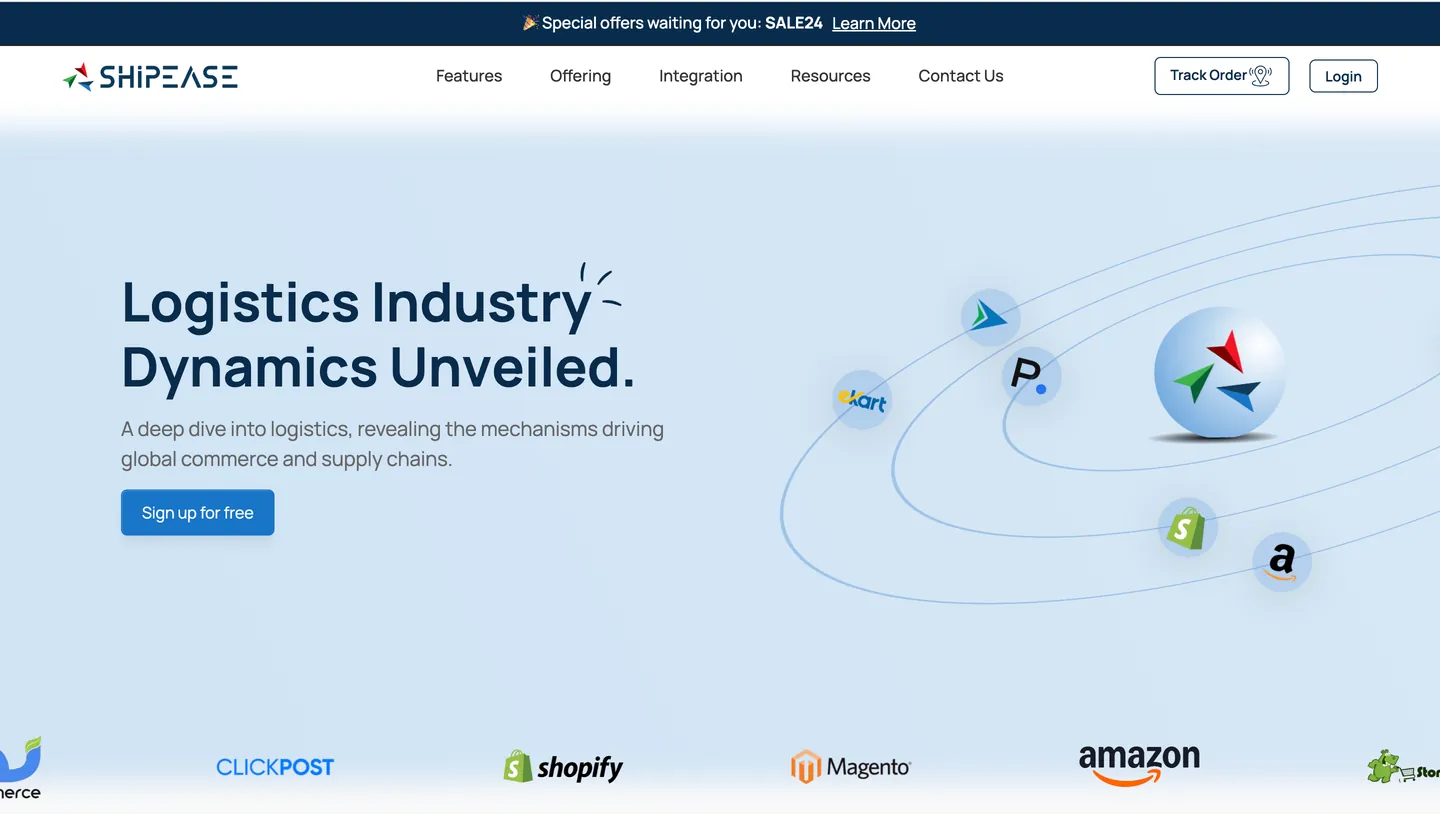
Ackrolix built the public website to speak to several audiences from the first screen. The homepage design adapted its messaging to the visitor type (retailer, logistics partner or developer) and pointed each one toward the right next step.
The homepage shown below captures that approach. The hero reads "Logistics Industry Dynamics Unveiled" with a "Sign up for free" call to action, while the top navigation offers Features, Offering, Integration, Resources and Contact Us alongside "Track Order" and "Login" buttons. On the right, an orbit graphic places the ShipEase mark among channel icons, and a logo strip along the bottom presents eCommerce platforms such as Shopify, Magento and Amazon. This is the integration showcase the requirement called for: it tells sellers which of their sales channels can connect to the platform before they sign up.
- Interactive service showcase demonstrating the shipping workflow from order to delivery.
- Coverage map visualization with a pin code checker for serviceable areas and partner availability.
- Partner ecosystem display with logos and profiles of integrated courier partners.
- Pricing calculator estimating shipping cost from origin, destination and weight.
- Direct access to API documentation and the sandbox environment.
- Trust elements: customer success stories, service level commitments, and information on data protection and logistics industry standards.
05 / The project
Retailer dashboard, partner portal, developer platform and PWA
Behind the public site, Ackrolix delivered three working applications that shared the same shipment data. Each was designed around the daily tasks of its users rather than a generic admin layout.
Retailer and seller dashboard
The seller dashboard covered the full shipment lifecycle, from booking through returns and reporting.
- Quick Ship interface with carrier recommendations based on cost, speed and reliability.
- CSV/Excel bulk upload for processing hundreds of orders at once.
- Automatic order sync from connected Shopify, WooCommerce and marketplace accounts.
- Side-by-side multi-carrier rate comparison with expected delivery dates.
- Print-ready labels with barcodes and carrier information, plus end-of-day pickup manifests.
- Unified tracking across carriers with NDR (Non-Delivery Report) management, exception alerts and digital proof of delivery.
- Automated tracking links sent to customers by SMS and email.
- Reverse logistics portal, return label generation, RTO (Return to Origin) handling and return analytics.
- Performance, cost and geographic analytics by region, pin code and state, with downloadable reports.
Logistics partner portal
Courier partners received a mobile-friendly workspace for dispatch, delivery and billing.
- Prioritized order queue and pickup scheduling with routing optimization.
- Mobile barcode scanning for package verification and batch grouping for route planning.
- Touch-friendly delivery interface with offline status updates that sync when connectivity returns.
- GPS integration for route optimization and delivery verification.
- Photo and signature proof-of-delivery capture.
- Exception workflows for non-deliveries, address corrections and unavailable customers.
- Delivery metrics, SLA monitoring (on-time percentage, first-attempt success), automated invoicing and payment tracking.
Developer platform and API
The developer hub let technical teams build integrations without waiting on ShipEase support.
- Interactive API explorer with live request and response examples.
- Step-by-step integration guides, authentication and API key documentation, and rate-limit policies.
- Shipping Rate, Shipment Creation, Tracking and Serviceability Check APIs.
- Webhook events for order booked, picked up, in transit, out for delivery, delivered and exceptions.
- SDKs for Node.js, Python, PHP and Ruby, a Postman collection, code examples and a sandbox with dummy data.
Progressive web app for retailers and delivery agents
Because many users worked on phones in the field, Ackrolix built ShipEase as a progressive web app. Delivery agents could install it to their home screen and keep working with intermittent connectivity, without going through an app store.
Mobile interactions were designed for one-handed use, with gestures handled through Hammer.js and touch-optimized carousels built with Swiper.
- Add to Home Screen installation with adaptive icons for different devices.
- Service workers caching critical data for offline access.
- Push notifications for shipment updates and delivery exceptions.
- Background sync that queued API requests offline and sent them when connectivity was restored.
- Swipe actions, pull-to-refresh and a bottom navigation bar for thumb-friendly use.
- Data saver mode with reduced image quality and deferred loading.
- Camera integration for barcode scanning and POD photos, and GPS for agent navigation.
06 / The project
How did Ackrolix integrate couriers and eCommerce platforms with ShipEase?
Integration was the core of the product. Backend developers and integration specialists connected third-party courier APIs and normalized their rates and tracking into a consistent format, while a separate track of work built connectors for the storefronts sellers already used.
RabbitMQ handled asynchronous processing and webhook delivery, and Socket.io WebSockets pushed live tracking updates to retailers and customers. Redis cached frequently used and real-time data to keep rate lookups responsive.
- Shopify plugin with one-click installation, automatic order sync and embedded tracking.
- WooCommerce extension delivered as a WordPress plugin.
- Magento module for Magento 2 stores.
- Custom RESTful API for custom-built eCommerce platforms.
- Marketplace connectors for Amazon and Flipkart order integration via seller APIs.
07 / The project
Shipment and delivery workflows
The modules connected into a single order-to-delivery flow, with returns handled through the same platform. The steps below summarize how a shipment moved through ShipEase as documented.
- Orders arrive by automatic sync from connected stores and marketplaces, CSV/Excel bulk upload or the Shipment Creation API.
- The seller compares carrier rates and expected delivery dates, or accepts the recommended carrier, and prints the label.
- An end-of-day manifest is generated and the pickup is scheduled with the courier partner.
- The courier agent scans and verifies packages, then updates status in transit, including offline.
- Webhooks, WebSocket updates and SMS/email alerts notify the retailer and the end customer at each milestone.
- On delivery, the agent captures a photo and signature as digital proof; exceptions route into NDR handling.
- Returns and RTO shipments are initiated from the reverse logistics portal with a generated return label.
- Completed deliveries feed automated courier invoicing, payment reconciliation and analytics.
08 / The project
ShipEase project team, timeline and methodology
Ackrolix staffed the project with a team of 18 professionals over 9 months. Courier API integrations and eCommerce connectors ran in parallel with core platform development, which kept the overall schedule compact.
Delivery followed Agile Scrum with 2-week sprints, 18 sprints in total, with weekly stakeholder demos and a beta launch with select retailers before full production launch.
- Discovery and logistics workflow analysis: 4 weeks.
- API architecture and integration planning: 3 weeks.
- UI/UX design for web, mobile and developer portal: 6 weeks.
- Core platform development: 14 weeks.
- Courier partner API integrations: 8 weeks (parallel).
- eCommerce platform connectors: 6 weeks (parallel).
- PWA implementation: 4 weeks; developer documentation and sandbox: 4 weeks.
- Integration testing and QA: 5 weeks; beta launch with select retailers: 3 weeks; full production launch: 2 weeks.
- Bi-weekly courier partner sync meetings and monthly beta retailer feedback sessions.
- Continuous deployment, real-time monitoring and incident response, and performance benchmarking every sprint.
| Role | Count | Responsibility |
|---|---|---|
| Business Analyst | 1 | Requirements gathering, logistics workflow mapping, API design |
| Project Manager | 1 | Sprint planning, stakeholder coordination, delivery oversight |
| UI/UX Designer | 2 | Dashboard design, mobile UX, PWA interface, developer portal |
| Frontend Developers | 3 | React.js development, Next.js implementation, PWA features |
| Backend Developers | 4 | API development, courier integrations, webhook system, real-time updates |
| Mobile Developer | 2 | PWA optimization, offline functionality, native feature integration |
| DevOps Engineer | 1 | Cloud infrastructure, deployment automation, monitoring |
| QA Engineer | 2 | Functional testing, API testing, mobile testing, load testing |
| Integration Specialist | 2 | Third-party courier API integration, eCommerce platform connectors |
09 / The project
What technology stack powered the ShipEase platform?
The frontend used React and Next.js with Tailwind CSS, and the backend ran on Node.js and Express. Data was split by workload: PostgreSQL for orders, shipments and users, MongoDB for logs and tracking data, and Redis for caching and real-time data. The platform ran on AWS with Docker, Kubernetes and GitHub Actions CI/CD.
| Layer | Technologies |
|---|---|
| Frontend | React.js, Next.js, React Router 6 |
| Styling and animation | Tailwind CSS, CSS3, GSAP, Framer Motion |
| UI libraries | Swiper, Hammer.js, Font Awesome, Lucide, Google Fonts API |
| PWA | Service Workers, Web App Manifest, Push Notifications, Background Sync |
| Backend | Node.js, Express.js |
| Databases | PostgreSQL (orders, shipments, users), MongoDB (logs, tracking data), Redis (caching, real-time data) |
| Real-time and messaging | WebSockets (Socket.io), RabbitMQ (async processing, webhook delivery) |
| Cloud and delivery | AWS (EC2, S3, CloudFront, SES, Lambda), Cloudflare, Nginx on Ubuntu |
| Authentication and security | JWT, OAuth 2.0, SSL/TLS, rate limiting, API key authentication |
| Payments | Razorpay, Stripe (COD reconciliation, wallet) |
| Notifications | AWS SES, SendGrid (email); Twilio, MSG91 (SMS) |
| API documentation | Swagger/OpenAPI, Postman collections |
| Monitoring | Datadog, Sentry, CloudWatch |
| DevOps | Docker, Kubernetes, CI/CD (GitHub Actions) |
| Performance and SEO | Priority Hints, lazy loading, code splitting, Open Graph, structured data |
10 / The project
Outcomes reported for the ShipEase platform
Ackrolix's project documentation reports outcomes qualitatively rather than as measured figures. It does not provide a quantified baseline for shipping cost, delivery time or uptime, so no percentages are claimed here.
Platform launch and adoption
According to the project documentation, the multi-sided platform launched serving retailers and logistics partners.
- Multiple courier partners were onboarded, expanding coverage across major Indian cities and serviceable pin codes.
- A retailer user base was established across eCommerce segments, and developers integrated the platform with diverse eCommerce systems.
Retailers and sellers
The documentation reports that sellers could reach multiple logistics partners through a single integration.
- Real-time rate comparison to help optimize shipping costs.
- Bulk order processing that reduced operational overhead.
- Automated tracking that replaced manual courier coordination, and simpler returns management.
Logistics partners
Courier operations were digitized and moved onto mobile tools.
- Real-time status updates improved tracking accuracy.
- Streamlined pickup coordination aimed at fewer failed pickups.
- Automated billing and reconciliation to reduce payment delays, and better exception management.
Technical performance and developers
The documentation reports fast page loads, smooth WebSocket tracking updates, and handling of traffic spikes during sales events without degradation.
- PWA offline functionality was used by delivery agents.
- Developers adopted the APIs across Shopify, WooCommerce and custom store integrations, with the sandbox reported to reduce integration time.
- Webhook delivery supported real-time shipment status updates in retailer systems.
Operations and customer experience
Automation replaced several manual steps.
- Automated rate comparison removed manual quote gathering, and automated manifests streamlined pickups.
- Digital POD replaced paper-based delivery confirmation.
- Automated notifications were reported to reduce "where is my order" support queries, and real-time exception alerts enabled proactive issue resolution.
11 / The project
Why the ShipEase project matters
Logistics for growing eCommerce businesses is fragmented: each courier has its own rates, coverage, tracking format and billing. The ShipEase platform consolidated multiple courier partners behind one interface and one API, removing the need for sellers to integrate with each provider separately.
The architecture was also built to grow. An API-first design, an integration layer designed so new courier partners could be added easily, a PWA framework ready to evolve into native mobile apps, and a centralized analytics foundation gave ShipEase room to add channels, carriers and future optimization features. For companies planning a logistics aggregation or shipment tracking platform, the project shows how Ackrolix approaches multi-party integration, real-time data and field-ready mobile tools in a single delivery.
Technology used
Questions about this project
What did Ackrolix build for ShipEase?
Ackrolix designed and developed a logistics platform delivered as a progressive web app: a public marketing website, a retailer and seller dashboard, a logistics partner portal, a developer platform with APIs and a sandbox, and customer-facing tracking with SMS and email alerts.
Which eCommerce platforms and marketplaces did the ShipEase platform integrate with?
The project documentation lists a Shopify plugin, a WooCommerce extension, a Magento 2 module, a RESTful API for custom-built stores, and Amazon and Flipkart order integration through seller APIs.
How long did the ShipEase project take and how large was the team?
The project ran for 9 months with a team of 18 professionals, including business analysis, project management, UI/UX design, frontend, backend and mobile development, DevOps, QA and integration specialists. Delivery used Agile Scrum with 18 two-week sprints.
How were courier rates and tracking from different carriers handled?
Backend developers and integration specialists connected courier partner APIs and normalized rates and tracking data into one format. RabbitMQ handled asynchronous processing and webhook delivery, Socket.io WebSockets pushed live tracking updates, and Redis cached real-time data.
Could delivery agents use the platform without a stable internet connection?
Yes. The PWA used service workers to cache critical data and background sync to queue status updates offline and send them once connectivity returned. Agents could also scan barcodes and capture photo and signature proof of delivery from their phones.
What technology stack did Ackrolix use for ShipEase?
React and Next.js with Tailwind CSS on the frontend; Node.js and Express on the backend; PostgreSQL, MongoDB and Redis for data; RabbitMQ and Socket.io for messaging and real-time updates; and AWS, Docker, Kubernetes and GitHub Actions for hosting and deployment.
Prepared by Ackrolix Innovations from its development portfolio, pages 88, 89, 90, 91, 92, 93, 94, 95, 96, 97, 98, 99, 100, 101. Reported results relate to the documented project period. About the team.