
01 / The client
About Samanya Gyan, a UPSC preparation platform
Samanya Gyan is an education technology platform focused on UPSC (Union Public Service Commission) and civil services exam preparation. It positions itself as a one-stop destination for aspirants, combining expert mentorship, study resources and interactive learning tools for one of India's most demanding competitive examinations.
The platform is built around passion-driven mentorship and exam-oriented preparation. Its instructors aim to go beyond traditional coaching through personalized attention, real-time doubt resolution and full syllabus coverage. Samanya Gyan came to Ackrolix Innovations for a digital learning platform that could carry the complete preparation journey online, from free study material to paid courses, live classes and mock tests.
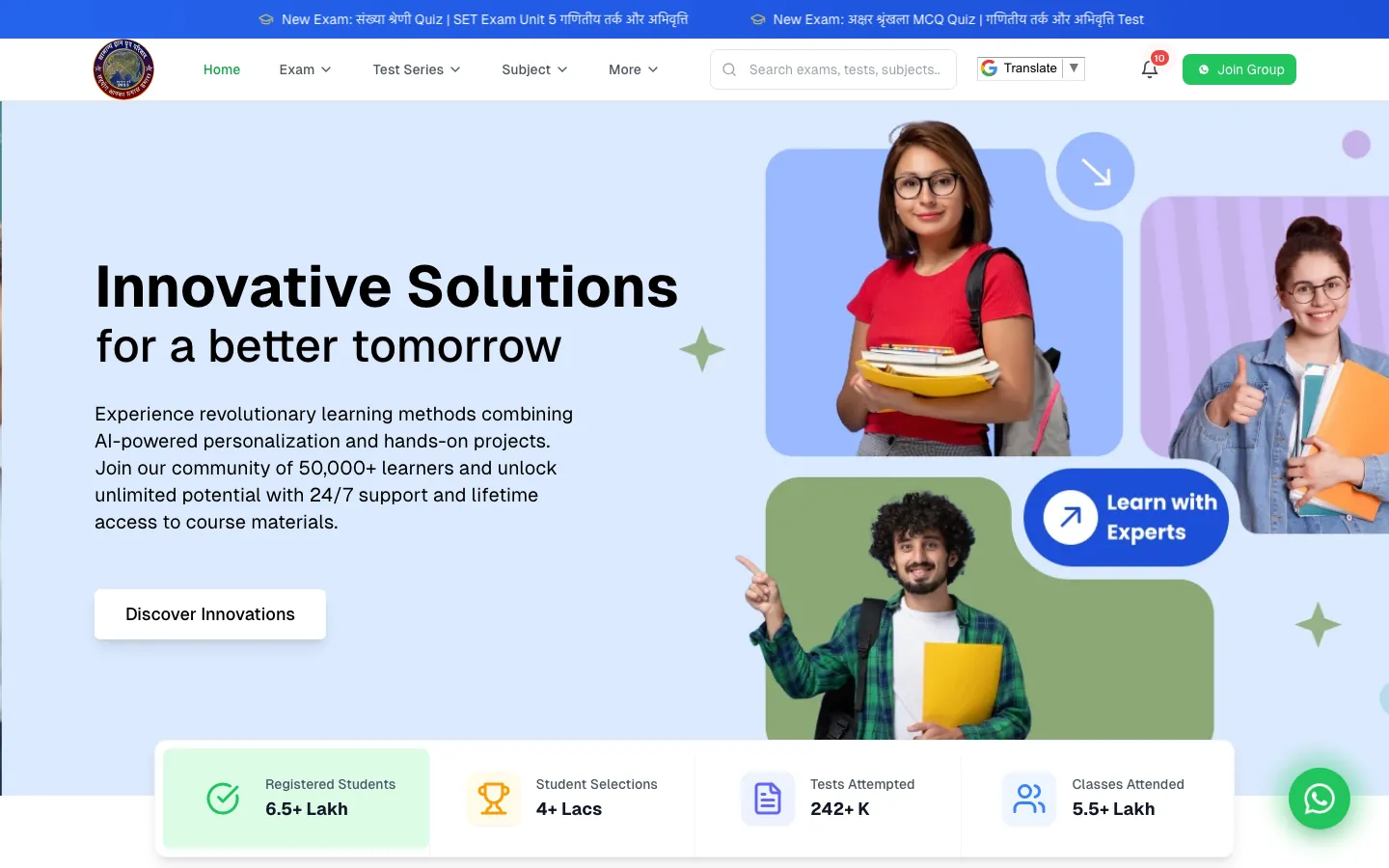
The homepage shown below reflects that scope. The top navigation groups content under Exam, Test Series and Subject menus, a search bar invites students to look up exams, tests and subjects, and a Translate control and Join Group button sit alongside a notification bell. A ticker above the header announces newly added exams and quizzes. Beneath the hero, a statistics strip summarizes the community at a glance: registered students, student selections, tests attempted and classes attended.
- Industry: education technology, competitive exam preparation.
- Business model: online learning platform with free and paid tiers.
- Audience: civil services aspirants across India, including students in Tier 2 and Tier 3 cities.
- Industry
- Education
- Services / expertise
- EdTech Platform Development · UPSC Learning Platform · LMS Development
- Business model
- Online learning platform with freemium subscriptions
- Platforms
- Public website, student learning portal, AMP pages, Progressive Web App
- Team size
- 22 professionals
- Duration
- 7 months (14 two-week sprints)
- Client website
- Visit Samanya Gyan ↗
Planning a similar project? Explore our website design and development and custom software development services for education projects.
02 / The project
What Samanya Gyan needed from the platform
Samanya Gyan needed a single digital platform covering the full UPSC preparation journey. The requirements spanned learning content, assessment, mentorship, mobile access, monetization and organic growth, and each area had to work for students preparing over many months.
Comprehensive learning platform
The core requirement was structured coverage of the entire UPSC syllabus, delivered in several formats and kept current every day.
- Courses for General Studies papers 1 to 4, CSAT, optional subjects, essay writing and interview preparation.
- Video lectures, PDF notes, current affairs, quizzes, mock tests and practice questions.
- Daily current affairs linked to the static syllabus.
- Live classes and doubt sessions with mentors.
- Personalized study paths based on available time, target exam date and preparation level.
Student engagement and assessment
Students needed realistic exam practice and clear visibility into their own progress.
- Full-length Prelims and Mains mock tests with performance analysis.
- Answer-writing practice with mentor feedback.
- Progress dashboards showing completion, strengths, weak areas and trends.
- Subject-wise analytics, topic mastery and time management insights.
- Study streaks, achievement badges and milestones.
Mentorship and support
Mentorship is central to Samanya Gyan's approach, so the platform had to support several levels of access to faculty and peers.
- Access to experienced UPSC trainers and civil servants as mentors.
- Scheduled live Q&A sessions for doubt resolution.
- One-on-one mentorship for premium subscribers covering strategy, optional subject selection and interview preparation.
- Discussion forums for peer learning.
Mobile accessibility and performance
Many aspirants study on phones during commutes or without a laptop, often on slower connections outside metro cities.
- Mobile-first design and fast load times.
- Downloadable content for offline study.
- AMP pages for blog and current affairs content.
- A Progressive Web App that works without an app store download.
Monetization, SEO and content strategy
The business model needed to attract students with free content and convert them to paid plans, while daily publishing drove organic discovery.
- Freemium access with monthly, quarterly and annual plans.
- Subject-wise packages for individual optional subjects.
- Google AdSense on free content and affiliate recommendations for books and course material.
- Ranking for UPSC preparation keywords through daily publishing and post-exam analysis.
03 / The project
Challenges in building a UPSC learning platform
The UPSC syllabus is vast, preparation cycles run for 12 to 18 months, and students range from metro cities to remote areas with intermittent connectivity. Ackrolix had to address content, engagement, competitive, technical and monetization challenges at the same time.
Content management
Organizing the syllabus across History, Geography, Polity, Economics, Science, Current Affairs, Ethics, Essay and optional subjects into a digestible structure was the first hurdle.
- Publishing and linking fresh current affairs every day without losing quality or exam relevance.
- Updating the content library quickly when UPSC changes the syllabus or exam pattern.
- Unifying text notes, videos, PDFs, quizzes and mock tests into one learning experience.
Student engagement
Long preparation cycles make motivation and consistency hard to sustain online.
- Reducing dropout across months of preparation.
- Delivering personalized attention and adaptive paths to thousands of concurrent students.
- Running live doubt sessions for large audiences without technical issues.
Competitive landscape
Samanya Gyan competes with established offline coaching institutes that have long-standing brand recognition, and with abundant free UPSC content on YouTube and blogs.
- Differentiating through quality and structure rather than volume of free content.
- Balancing affordable pricing for price-sensitive aspirants with business sustainability.
Technical and performance
Performance had to hold up across very different network conditions in India.
- Smooth lecture playback from metro cities to villages.
- Fast page loads across varied internet infrastructure.
- Traffic spikes around exam results and answer key publications.
- Offline access for students with intermittent connectivity.
Monetization
The free tier had to deliver enough value to build trust while keeping premium features worth paying for.
- Converting free users into subscribers through demonstrated value.
- Retaining subscribers across a multi-month preparation journey.
04 / The project
Public website and content hub
Ackrolix designed and developed Samanya Gyan as a mobile-first EdTech platform on Next.js 16 with Turbopack, AMP optimization and a modern component system. The public website acts as the content hub, using static generation for content pages, dynamic rendering for personalized dashboards, and a full sitemap with structured data.
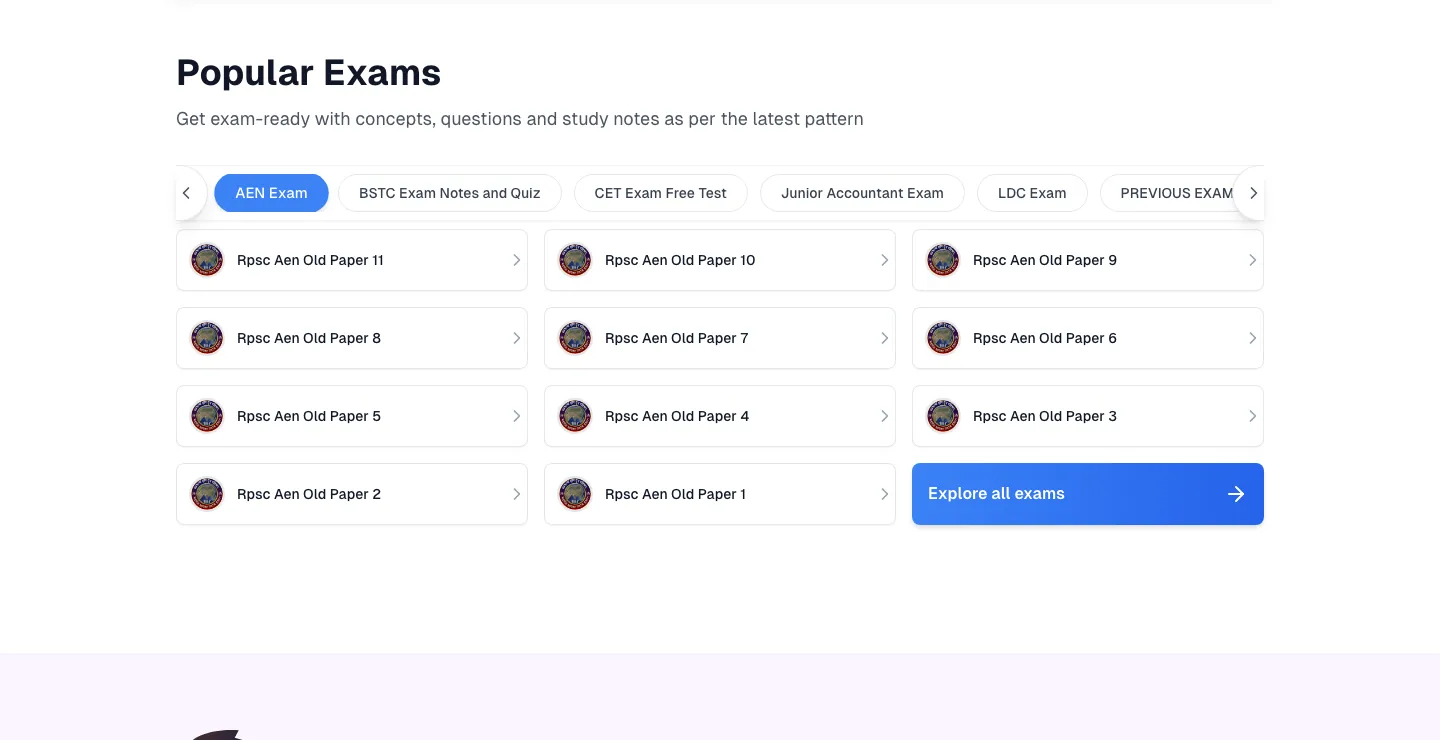
The resource library is one of the hub's most visible features. In the Popular Exams section shown below, a scrollable row of tabs separates exams such as AEN Exam, BSTC Exam Notes and Quiz, CET Exam Free Test, Junior Accountant Exam and LDC Exam. The selected AEN tab lists RPSC AEN old papers 1 to 11 as individual cards, with an Explore all exams button leading to the wider catalog. This is the searchable, filterable repository of previous papers and study material the requirements called for.
- Next.js 16 with Turbopack for fast builds and page transitions.
- AMP pages for blog and current affairs content, documented to load in under one second even on 2G and 3G networks.
- Radix UI, shadcn/ui and Tailwind CSS for an accessible, responsive design system.
- Framer Motion micro-interactions that keep performance in check.
- Automated daily current affairs workflow, categorized by UPSC syllabus topic.
- Searchable resource library of study materials, previous year papers and free downloads.
05 / The project
How does the Samanya Gyan student portal support learning and assessment?
The student learning portal is where enrolled students study, practice and track progress. It combines course content, live sessions, assessments and personalization under one login.
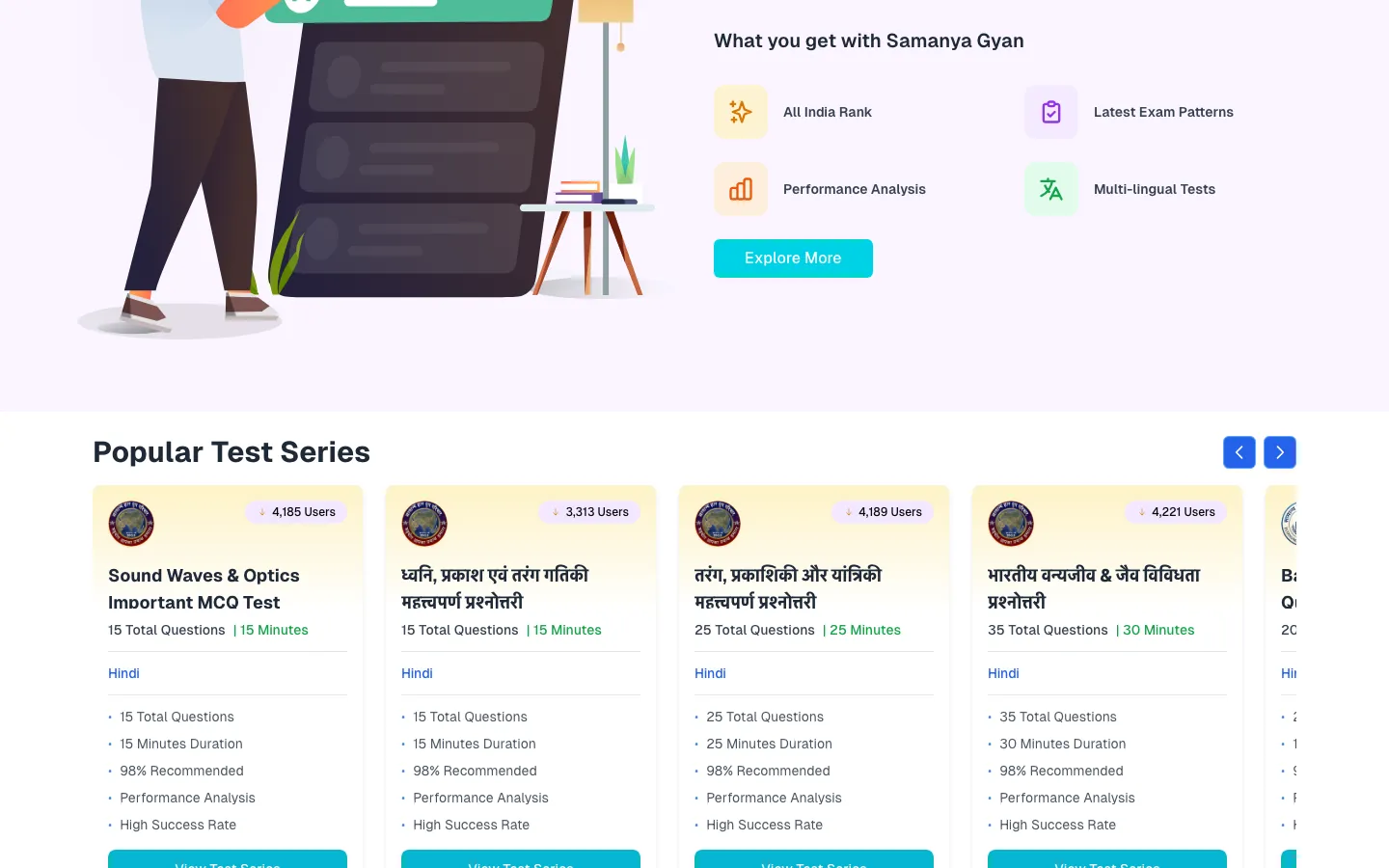
The homepage sections shown below preview the assessment side of the portal. A "What you get with Samanya Gyan" panel lists All India Rank, Latest Exam Patterns, Performance Analysis and Multi-lingual Tests. Beneath it, a Popular Test Series carousel presents test cards, several titled in Hindi, each showing the number of questions, duration, language and a View Test Series button. The user counts and recommendation percentages printed on the cards are live site copy, not Ackrolix-reported results.
Dashboard and progress tracking
Each student gets a personalized dashboard built around their enrolled courses and daily goals.
- Progress indicators per subject and topic with completion percentages.
- Study streaks with badges for consecutive study days.
- Graphs of mock test scores and improvement trends.
- Upcoming live class schedule with calendar integration and reminders.
Course and content structure
Courses follow the UPSC syllabus across GS papers and optional subjects, with a recommended order of study.
- Sequential learning paths with prerequisites.
- Video player with playback speed control, note-taking and bookmarks.
- Downloadable PDF notes for each topic.
- Chapter-wise quizzes with instant feedback.
- A revision scheduler using spaced repetition.
Live interactive features
Live sessions bring mentors and students together in real time.
- Scheduled live classes with screen sharing, chat and Q&A.
- Live doubt-solving sessions with real-time mentor responses.
- Recordings available within hours for students who miss a session.
- Attendance tracking, participation metrics, and in-session polls and quizzes.
Assessment and practice
The mock test engine mirrors the exam pattern so students can practice under realistic conditions.
- Full-length Prelims mock tests with 100 questions over 2 hours.
- Mains mock tests covering essay, GS papers and optional subjects.
- Topic-wise practice tests and previous year papers with detailed solutions and video explanations.
- Answer-writing submission portal with mentor evaluation.
- Analytics for subject-wise strengths, weak areas, accuracy and time management.
Personalization and mentorship
Personalization features help students decide what to study next and where to get help.
- AI-driven study plan generator based on study hours, target exam date and current level.
- Recommendation engine that suggests topics for revision based on quiz and test performance.
- One-on-one mentorship for premium subscribers.
- Ask a Mentor for written questions, with expert responses within 24 hours.
- Peer study groups and discussion forums.
06 / The project
Mobile experience with AMP and a Progressive Web App
Because many aspirants study on phones over limited data plans, Ackrolix treated mobile as the primary experience rather than an adaptation. AMP covers current affairs, blog posts and static content, while the Progressive Web App gives students an app-like experience without an app store download.
The mobile layer also accounts for students in areas with unreliable connectivity, letting them download lectures and reduce data usage.
- AMP pages for current affairs, blog and static content.
- Add to home screen, offline content access and push notifications through the PWA.
- Offline video downloads for study without an internet connection.
- Data saver mode with reduced video quality and image compression.
- Touch-optimized UI with swipe gestures and thumb-friendly navigation.
- Push notifications for study reminders, new content, test deadlines and live classes.
07 / The project
How did Ackrolix integrate payments, subscriptions, SEO and analytics?
Samanya Gyan's freemium model depends on a smooth path from free content to paid plans. Ackrolix built tiered subscriptions with Razorpay payments, added AdSense to the free tier, and set up the SEO and analytics foundation that drives and measures growth.
Subscription plans
Four tiers address different student needs and budgets.
- Free: limited sample lectures, daily current affairs and basic quizzes.
- Basic: video lectures and notes for selected subjects.
- Premium: complete course access, mock tests, answer-writing evaluation and live classes.
- Elite: Premium plus one-on-one mentorship, unlimited doubt sessions and exclusive content.
Razorpay payment integration
Razorpay handles payments using the methods Indian students commonly use.
- UPI, credit and debit cards, net banking and wallets.
- Monthly, quarterly and annual billing with discounts for longer commitments.
- A 7-day free trial of premium features.
- Referral discounts and family or group plans.
AdSense integration
Advertising supports the free tier without affecting paying students.
- Ad placement on free blog, current affairs and lecture pages.
- Ad-free experience for premium subscribers.
- Contextual, education-relevant ads and A/B tested ad positions.
SEO and content marketing
Daily publishing and a strong internal link structure support organic discovery.
- Automated daily current affairs publishing workflow.
- Targeting of UPSC keywords such as "UPSC preparation" and "IAS study material".
- Long-form guides and post-exam analysis with answer keys published within hours of an exam.
- Internal links from current affairs to static syllabus topics.
- Course, review and FAQ schema for rich results.
Analytics and optimization
Tracking covers the full student journey from first visit to purchase.
- Google Analytics 4 for acquisition, behavior flow, course completion and conversion funnels.
- Google Tag Manager events for video completion, quiz attempts and purchases.
- A custom admin dashboard for engagement, popular content and churn indicators.
- A/B testing of landing pages, pricing pages and calls to action.
08 / The project
Team, timeline and methodology
Ackrolix delivered the project over 7 months with a 22-person team that included UPSC content experts, video production specialists and an SEO specialist alongside designers and engineers. Work ran in Agile Scrum with 2-week sprints, 14 sprints in total.
The project followed a content-first approach. UPSC experts reviewed content weekly and students tested the product every two weeks, so the platform was shaped by both subject matter and real user behavior.
- Phases: discovery and content strategy; UX research and student personas; UI/UX design for website, portal and mobile; content management system development; student portal development; video integration and streaming; mock test engine; Razorpay payment integration; AMP implementation; beta testing with students; launch and stabilization.
- SEO optimization ran as an ongoing workstream.
- Methodology: Agile Scrum, weekly content reviews with UPSC experts, bi-weekly student user testing, A/B testing for conversion and a continuous deployment pipeline.
| Role | Count | Responsibility |
|---|---|---|
| Business Analyst | 1 | Requirements gathering, content strategy, student journey mapping |
| Project Manager | 1 | Sprint planning, timeline management, stakeholder coordination |
| UI/UX Designer | 2 | Website design, student portal UX, mobile optimization, AMP templates |
| Frontend Developer | 4 | Next.js 16 development, Radix UI/shadcn implementation, AMP pages, PWA |
| Backend Developer | 3 | API development, video streaming, subscription logic, content management |
| Mobile Developer | 2 | PWA optimization, offline functionality, push notifications |
| DevOps Engineer | 1 | Cloud infrastructure, CDN setup, deployment automation |
| QA Engineer | 2 | Functional testing, mobile testing, payment flow verification |
| Content Manager / UPSC Expert | 3 | Daily current affairs, course content curation, exam analysis |
| SEO Specialist | 1 | Keyword research, on-page optimization, content strategy |
| Video Production Specialist | 2 | Lecture recording, video editing, subtitle creation |
09 / The project
Technology stack behind Samanya Gyan
The stack pairs a Next.js front end with a Node.js back end on AWS. Rendering is split by page type: server-side rendering for student dashboards, static generation for blog and current affairs, and incremental static regeneration for course pages. MongoDB stores courses, content and user data, while PostgreSQL holds subscriptions and payments.
| Layer | Technologies |
|---|---|
| Frontend framework | React.js, Next.js 16.0.7 |
| Build tool | Turbopack |
| Mobile optimization | AMP for content pages, Progressive Web App |
| Rendering strategy | SSR (student dashboards), SSG (blog, current affairs), ISR (course pages) |
| UI and styling | Tailwind CSS, Radix UI, shadcn/ui, Framer Motion, Lucide icons, Google Fonts API |
| Web server | Nginx |
| Backend | Node.js, Express.js |
| Database | MongoDB (courses, content, user data), PostgreSQL (subscriptions, payments) |
| Video and file storage | AWS S3 + CloudFront with adaptive bitrate streaming |
| Cloud platform | AWS (EC2, S3, CloudFront, SES) |
| Authentication | JWT, OAuth 2.0, OTP verification |
| Payment gateway | Razorpay (UPI, cards, wallets, net banking) |
| Analytics and tags | Google Analytics 4, Microsoft Clarity, Google Tag Manager |
| Advertising | Google AdSense |
| Email and notifications | AWS SES, SendGrid, Firebase Cloud Messaging |
| Security | SSL/TLS, security headers, data encryption |
| Performance and SEO | Priority Hints, lazy loading, code splitting, Open Graph, XML sitemaps, structured data |
| CMS | Custom headless CMS |
10 / The project
Outcomes reported for the Samanya Gyan platform
Ackrolix's project documentation describes the outcomes qualitatively rather than with audited figures. The points below summarize what the documentation reports; they are not guarantees of exam results or a verified pass rate.
Adoption and reach
The documentation reports a launched UPSC preparation platform with a student base across India.
- Students in Tier 2 and Tier 3 cities as well as metros.
- Verified UPSC mentors and civil servants onboarded as faculty.
- An active daily user community.
Learning and content delivery
Structured content and regular practice are reported as active parts of the platform.
- Daily current affairs publishing and a video lecture library covering the syllabus.
- Study materials across GS papers and optional subjects, plus a mock test question bank.
- Mock test participation, answer-writing submissions and live class attendance.
- Positive student feedback on course quality and mentor support.
Performance and mobile use
The documentation reports fast mobile performance and use of the offline features.
- AMP pages with sub-one-second mobile load times.
- Strong Lighthouse and Core Web Vitals results and smooth video streaming.
- High mobile traffic, PWA adoption, offline video downloads and data saver usage.
Revenue and organic growth
The freemium model and SEO work are reported to be contributing to business sustainability.
- A launched freemium subscription model with growing monthly recurring revenue and renewals.
- High Razorpay transaction success rates and supplementary AdSense revenue.
- Organic traffic growth, first-page rankings for UPSC keywords and featured snippets.
- Community building through forums, social media, a YouTube channel, newsletters and referrals.
11 / The project
Why the Samanya Gyan platform matters
Samanya Gyan set out to make quality civil services coaching accessible to students regardless of location or budget. The platform brings mentor-led preparation, structured content and realistic practice to aspirants who may not have access to offline coaching, with mobile-first delivery for slower networks and limited data.
The project documentation frames the social impact simply: removing financial and geographic barriers gives aspirants from all backgrounds a fairer chance to prepare for public service. A freemium model with flexible pricing, live mentor interaction and offline-capable mobile access are the practical means the platform uses toward that goal.
- Mentor-led, exam-oriented preparation with live doubt resolution.
- Free content that lets students judge value before subscribing.
- Mobile and offline access for students outside major cities.
Technology used
Questions about this project
What did Ackrolix build for Samanya Gyan?
Ackrolix designed and developed a mobile-first UPSC preparation platform: a public website and content hub, a student learning portal with courses, live classes and mock tests, AMP pages and a Progressive Web App, plus subscription payments, AdSense, SEO and analytics.
How long did the project take and how large was the team?
The documented project ran for 7 months in 14 two-week Agile sprints, with a team of 22 professionals including developers, designers, QA, DevOps, UPSC content experts, video production specialists and an SEO specialist.
Which payment and third-party integrations does the platform use?
Payments run through Razorpay (UPI, cards, net banking and wallets). The platform also uses Google AdSense, Google Analytics 4, Google Tag Manager, Microsoft Clarity, Firebase Cloud Messaging for push notifications, and AWS SES and SendGrid for email.
What technology stack powers the platform?
The front end uses React and Next.js 16 with Turbopack, Tailwind CSS, Radix UI and shadcn/ui. The back end runs on Node.js and Express with MongoDB and PostgreSQL, hosted on AWS with S3 and CloudFront for files and video streaming.
How does the platform serve students with slow or intermittent internet?
AMP pages keep current affairs and blog content light, and the PWA supports add to home screen, offline content and push notifications. Students can download lectures for offline study and use a data saver mode that reduces video quality and image size.
Prepared by Ackrolix Innovations from its development portfolio, pages 56, 57, 58, 59, 60, 61, 62, 63, 64, 65, 66, 67, 68. Reported results relate to the documented project period. About the team.


