
01 / The client
JSGCRM overview: connect sales work to its next action
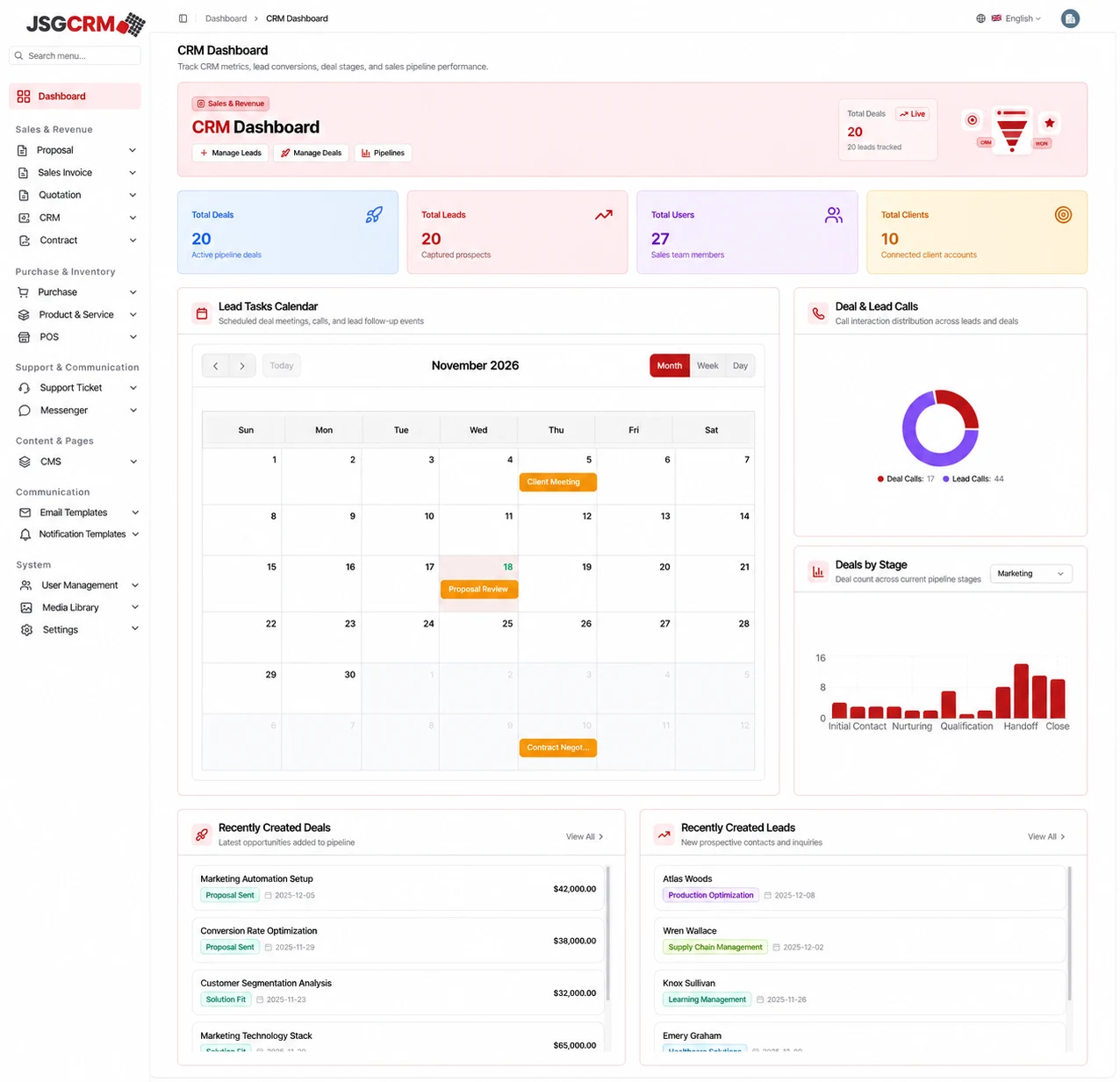
JSGCRM illustrates a sales workspace that connects customer enquiries with assigned people, commercial documents and pipeline review. Ackrolix looks at CRM development through the daily work of the sales team: what arrived, who owns it, what was promised and what should happen next.
The supplied screens extend beyond a contact list into quotations, invoices, returns, reporting and contracts. This case study explains that connected scope and the implementation decisions behind a custom customer relationship management application. It does not claim conversion improvements or a verified live production architecture.
- Industry
- Manufacturing, Enterprise Software
- Services / expertise
- CRM Development · Software Development · Sales Automation · Java Spring Boot · React.js · AWS Architecture
- Project focus
- JSGCRM business workflows
- Implementation
- Custom architecture proposed around agreed requirements
Planning a similar project? Explore our CRM development and custom software development services for manufacturing projects.
02 / The project
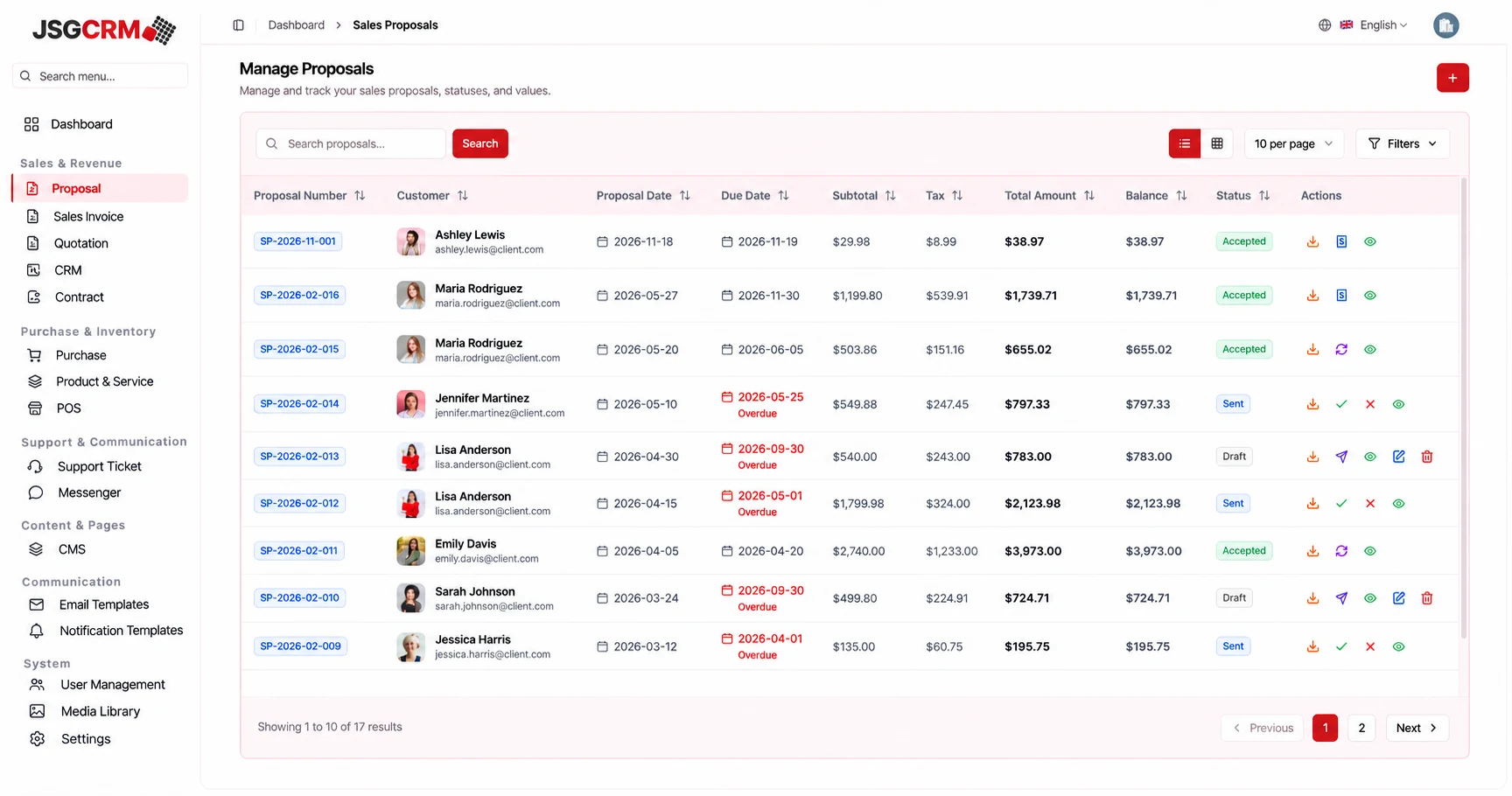
Proposals, quotations and invoicing without losing the customer context
A proposal records the commercial conversation before it becomes an invoice. A quotation gives the team structured customer, item and pricing information. Sales invoices and returns add balances, document states and adjustments that must remain linked to their original transaction.
Ackrolix would agree which fields carry forward, which require revalidation and who can approve a change. A salesperson should not have to recreate the customer history for accounts. At the same time, a CRM permission to update an enquiry should not automatically grant permission to alter a posted financial document.
03 / The project
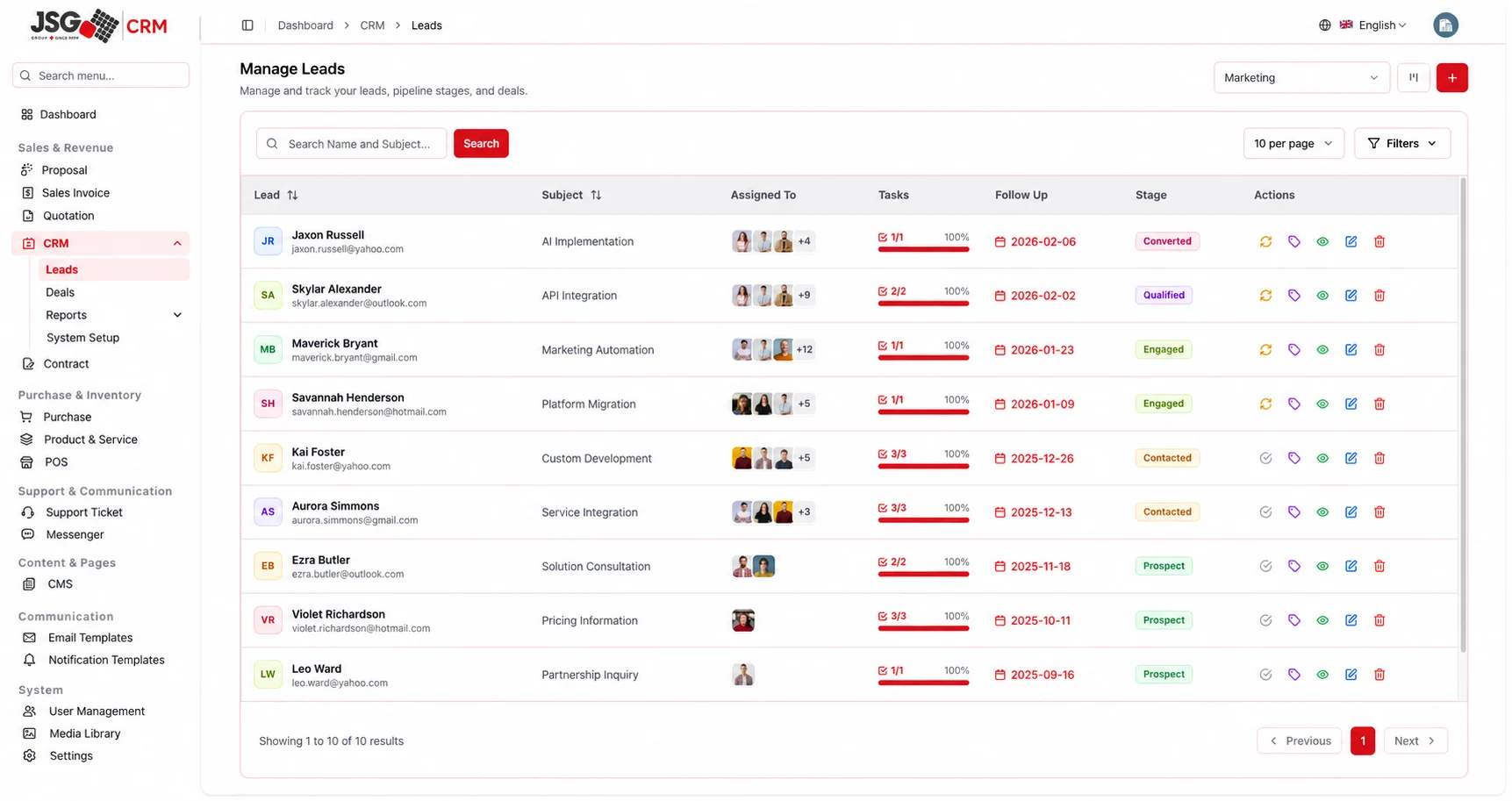
Lead ownership that survives team handovers
Lead records bring enquiry details, assigned users, tasks, products, acquisition sources and communication history together. Ownership is only meaningful if another user can understand the last interaction and the next expected action. A record should remain actionable after a colleague changes territory or leaves the team.
For a tailored CRM build, Ackrolix would model duplicate handling, reassignment, follow-up dates and required handover information with sales managers. File and call visibility would follow the customer-access model. Lead-source reporting should use maintained values so one campaign does not appear under several spellings.
04 / The project
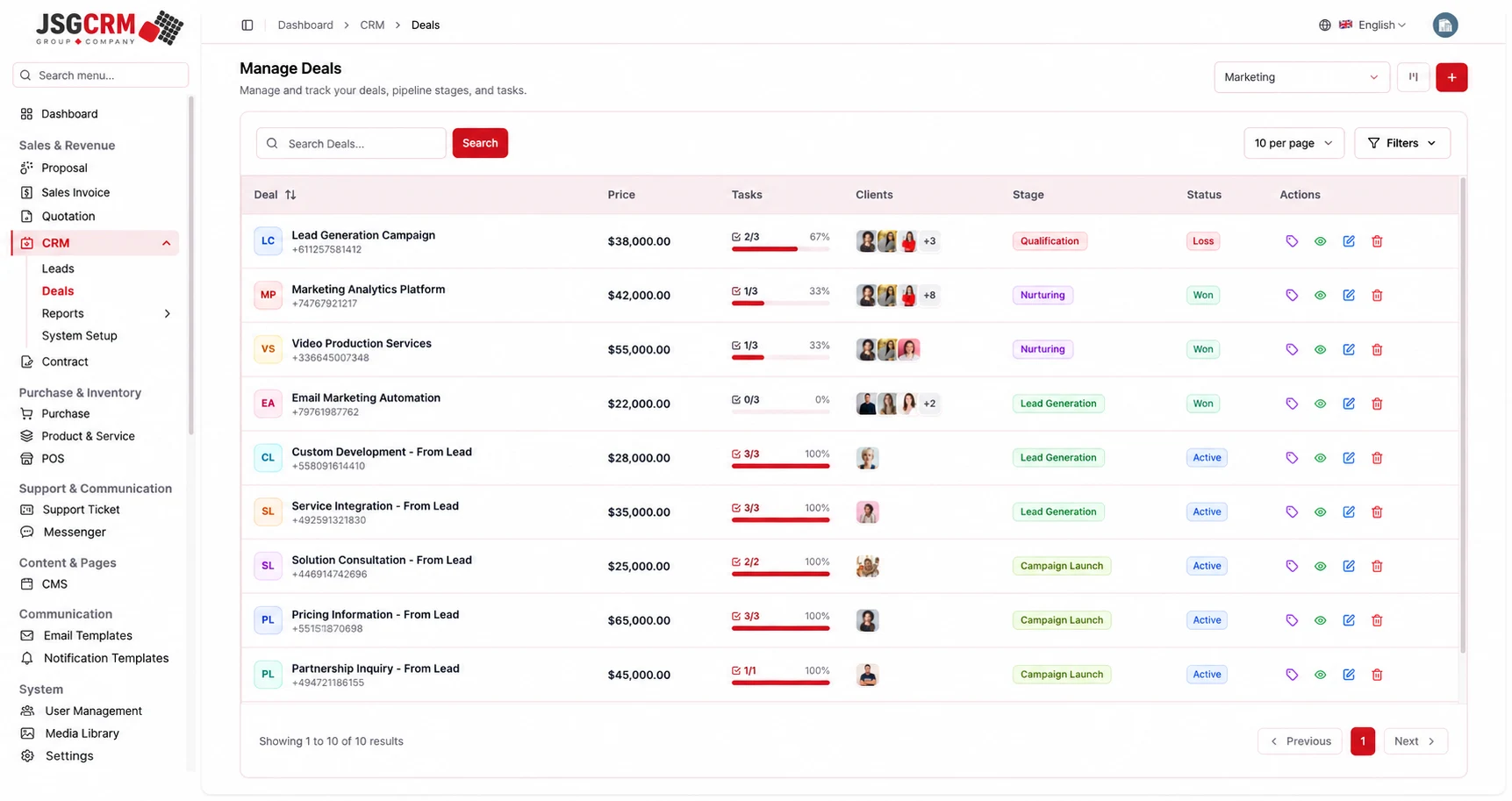
Deals and reports that use the same pipeline definitions
Deals describe a commercial opportunity with an expected value, stage and responsible person. Lead and deal reports can support review meetings only when those terms mean the same thing to the team. A chart is not useful if a closed opportunity remains active in another register.
Ackrolix would agree stage-entry rules, lost reasons and the point at which an enquiry becomes a deal. Reporting acceptance checks should reconcile sample records with the displayed totals. Forecasting, conversion rates or automated scoring would be separately specified rather than inferred from a dashboard.
05 / The project
Configuration that lets the process evolve deliberately
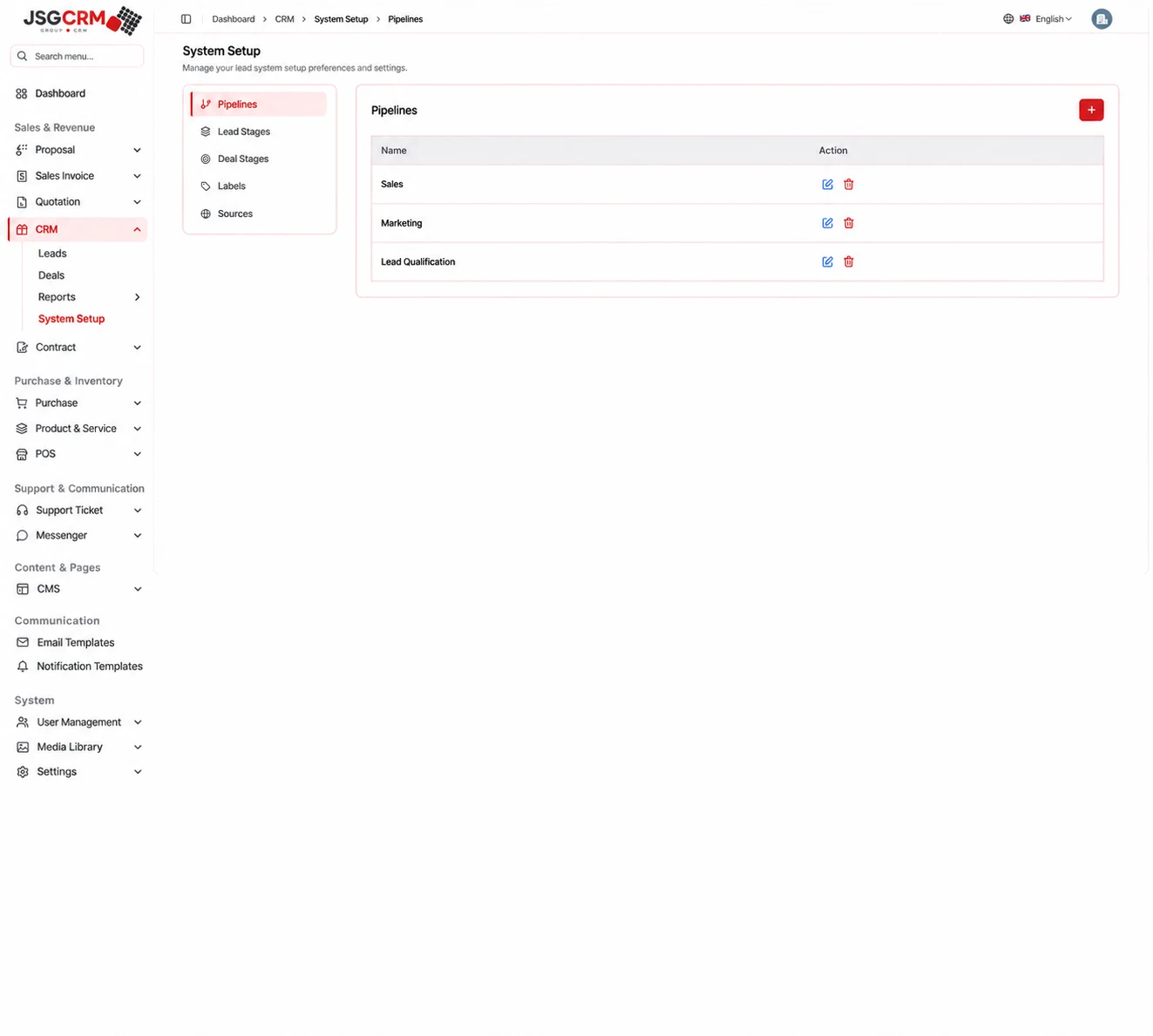
Pipeline, lead-stage, qualification, deal-stage, label and source settings make the CRM adaptable to different sales operations. That flexibility needs governance: changing a stage can affect active work, filters and historical reporting. Admin configuration should therefore carry clear ownership and predictable behaviour.
We would review which settings can be changed safely by administrators and which require a migration. Historical outcomes should not change simply because a label is renamed. In an Ackrolix CRM engagement, configuration scenarios become part of acceptance testing alongside ordinary sales-user journeys.
06 / The project
Contracts with a lifecycle beyond the opportunity
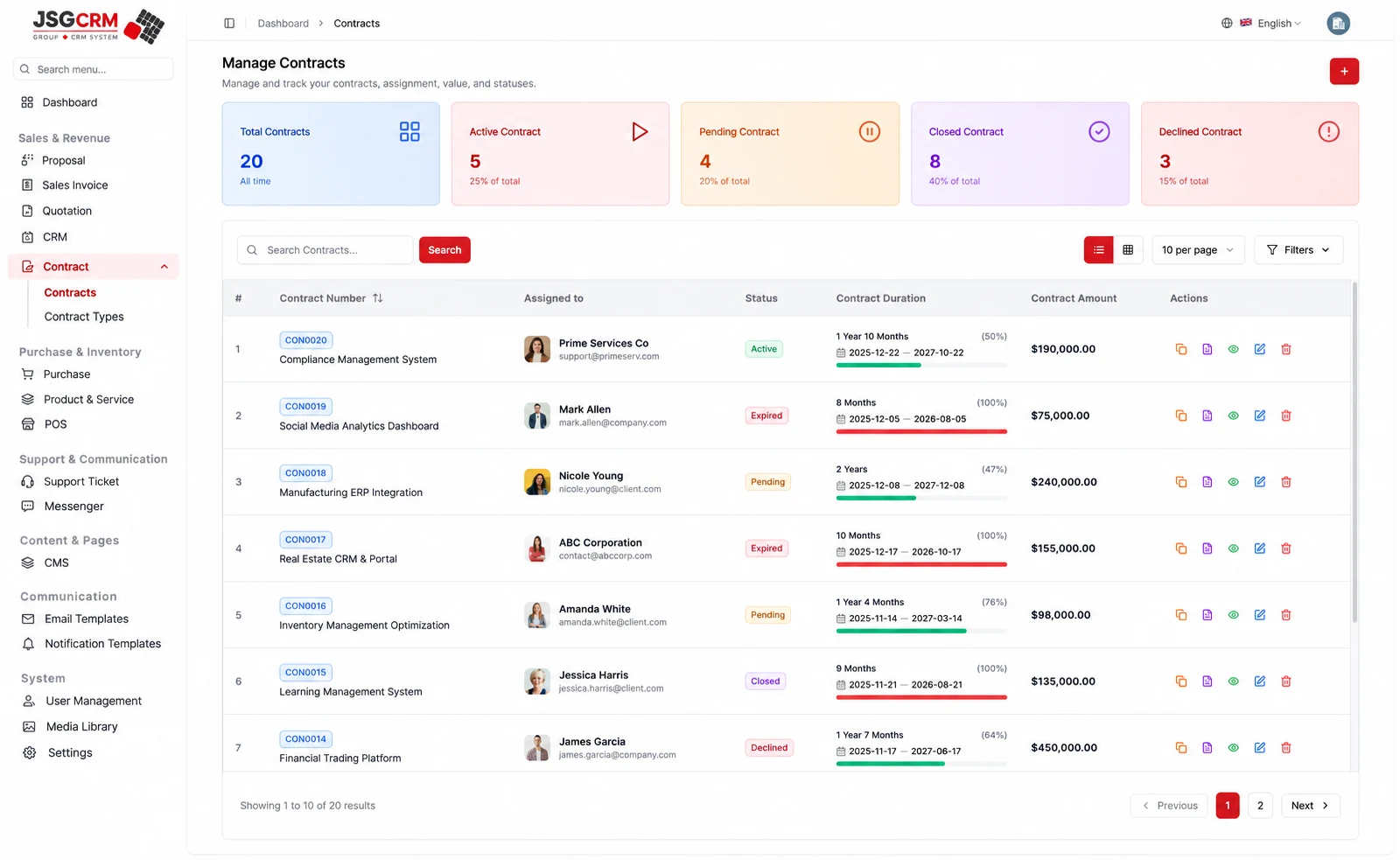
A contract register and contract types support administration after the commercial conversation has matured. Start and end dates, document attachments and renewal context become important even when the related deal is already closed. Keeping that relationship visible avoids treating the contract as an unrelated upload.
Ackrolix would define signature responsibilities, revision handling and renewal notifications as specific requirements. A stored contract does not establish an e-signature integration. The desired signing provider, evidence trail and access to confidential terms would be agreed before implementation.
07 / The project
An implementation plan built around domain boundaries
Ackrolix can turn the workflow into an implementation plan using React.js for the user interface, Java Spring Boot for business services and PostgreSQL for transactional data. These are proposed technology choices for a custom build, not a claim about the source application behind the supplied screens. We would validate them against existing systems, team skills, hosting constraints and support expectations.
Business capabilities should have clear ownership before they become separate microservices. A modular service can be a sensible starting point when deployment complexity would otherwise outweigh the benefit. API contracts, validation rules and transaction boundaries make future separation easier without imposing distributed infrastructure on every feature.
- Define roles and record-level access with business owners.
- Document REST API contracts, validation and integration failure paths.
- Use background processing for long-running imports and reports.
08 / The project
AWS operations, release controls and a measured scale plan
A production delivery plan needs recovery and observability alongside the feature backlog. Ackrolix would scope AWS infrastructure, database backups, private connectivity and secret management against the agreed operating requirements. Data residency and regional service availability must be checked before choosing a hosting region.
Docker builds and a CI/CD pipeline can provide repeatable releases, with automated checks, database migration review and a rollback procedure. Load testing should use realistic user journeys and report sizes. Monitoring should distinguish an application error from a slow integration or failed background job so the support team has an actionable signal.
- Test backup restoration and agree recovery targets.
- Separate development, review and production credentials.
- Review access logs, operational alerts and deployment approvals.
09 / The project
Start with the workflows your team needs to trust
For a project like JSGCRM, Ackrolix would begin with a focused discovery covering user roles, existing records and the decisions that need approval. We would prioritise a working vertical slice, review it with the users and agree acceptance criteria before expanding the scope.
Share the journeys that currently depend on repeated data entry or manual follow-up. Our custom software development team can translate those needs into a phased specification, integration plan and support approach. Estimates, delivery milestones and measurable success criteria follow that review rather than an assumed feature count.
- Review source data and migration quality early.
- Validate complete user journeys with the people who operate them.
- Agree training, handover and post-release responsibility.
10 / The project
Planning a similar software project in Dubai
For a Dubai business serving the UAE, discovery should capture language and timezone expectations, organisation boundaries and the systems already used by local operations. Hosting-region availability, data location and access for distributed staff need an explicit decision. Ackrolix can scope these requirements without assuming that every international feature belongs in the first release.
Technology used
Questions about this project
Can Ackrolix adapt this workflow to our organisation?
Yes. We first review roles, records, approvals and existing systems, then define the functionality and integrations your team needs.
What is the technology approach?
React.js, Spring Boot, PostgreSQL and AWS are proposed options. Final choices follow discovery; the supplied screens do not verify a production technology stack.
Workflow study based on supplied product interfaces and illustrative records. The original interface sources are ERPGo for CRM, HRMS and AMS, and Advocate SaaS for LFMS; branding has been adapted for presentation. The technical delivery approach is proposed, and no production results are asserted. About the team.


