01 / The client
About Rusan Healthcare
Rusan Healthcare is a distribution and marketing company for pharmaceutical and nutraceutical products in India. Its portfolio spans pain management, addiction treatment, movement disorders such as Parkinson's disease, advanced emergency kits and wellness solutions, and the organization emphasizes ethical practices, research and patient-centric healthcare delivery.
The company works on a B2B model, selling through a network of distributors and engaging hospitals and healthcare partners. Product, pricing and inventory data already lived in an established ERP system. Rusan came to Ackrolix for a digital platform that would give the business a credible online presence and give distributors a modern way to work with ERP data, without replacing the ERP itself.
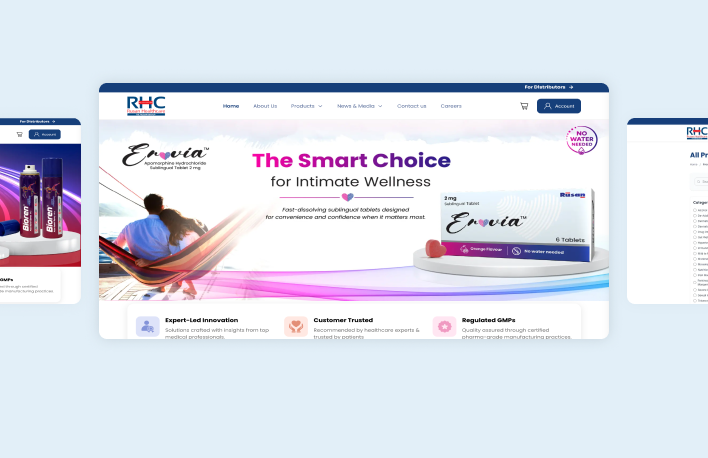
The homepage banner shown below is one example of how the public website presents Rusan's brands. It introduces the Ervia sublingual tablet with a headline, a short product message and packaging artwork, beneath a navigation bar with About Us, Products, News & Media, Contact us and Careers, plus a dedicated For Distributors link and an Account button at the top of the page.
- Industry: pharmaceutical distribution and healthcare.
- Business model: B2B distribution and marketing.
- Existing system of record: an established ERP for catalog, pricing, inventory and order fulfillment.
- Industry
- Healthcare
- Services / expertise
- Healthcare Website Development · Distributor Portal · ERP Integration
- Business model
- B2B pharmaceutical distribution and marketing
- Platforms
- Public website, distributor management system (web with PWA offline access), admin tools and ERP integration layer
- Team size
- 12 professionals
- Duration
- 10 months
Planning a similar project? Explore our website design and development and custom software development services for healthcare projects.
02 / The project
What did Rusan Healthcare need from its website and distributor platform?
Rusan needed two connected platforms: a corporate website that showcased its expertise and product portfolio, and a distributor management system (DMS) that exposed ERP data to its distributor network. Both had to draw product information from the ERP, while the marketing team needed to manage non-ERP content on its own.
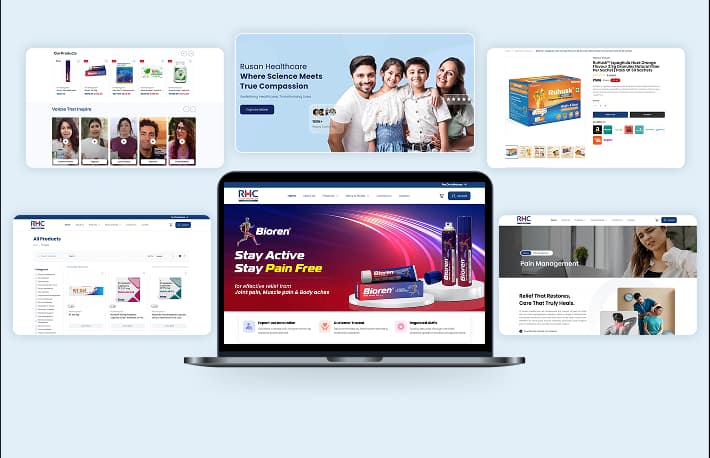
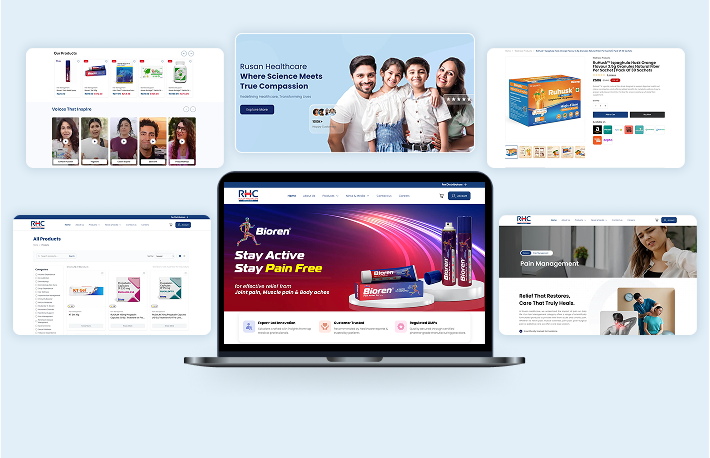
The homepage section shown below reflects the portfolio requirement. An "Our Products" carousel shows product cards labeled by therapeutic segment, such as Pain Management and Nutritional Support, and a "Voices That Inspire" row presents testimonial videos. This is the mix the requirements called for: categorized product information alongside promotional content that marketing can update independently.
Corporate website
The website had to establish a professional, trustworthy presence and turn visits into business inquiries.
- Display pharmaceutical and nutraceutical products by therapeutic segment, synced from the existing ERP.
- Capture inquiries from potential distributors, hospitals and healthcare partners.
- Support search visibility for products and therapeutic categories.
- Provide a reliable experience for healthcare professionals on mobile devices.
Distributor management system
Distributors needed a dedicated, secure place to see what they could order, at what price and with what stock.
- Distributor login with access to product information, pricing and inventory availability.
- Real-time synchronization with the ERP for catalog, pricing and inventory data.
- Order placement that syncs directly with the ERP for processing.
- A central repository for product catalogs, certificates, regulatory documents and marketing materials.
- A communication hub between Rusan and its distributors.
- Dashboards for sales performance, targets and analytics.
- Territory assignment and management of exclusive rights.
Content management
Marketing had to be able to update website content, news and promotional materials without developer help, while product information was displayed automatically from the ERP on both the website and the portal.
Performance and security
The platform had to scale with a growing distributor network and catalog, protect sensitive pricing, inventory and business data with enterprise security standards, load quickly across India on varying connections, and keep ERP synchronization accurate.
03 / The project
Challenges in building on top of an existing ERP
Most of the difficulty came from one constraint: the ERP had to stay the source of truth, so every screen depended on data that Ackrolix did not own and could not restructure. The team had to work within the ERP's existing API capabilities and data structures, without disrupting established ERP workflows.
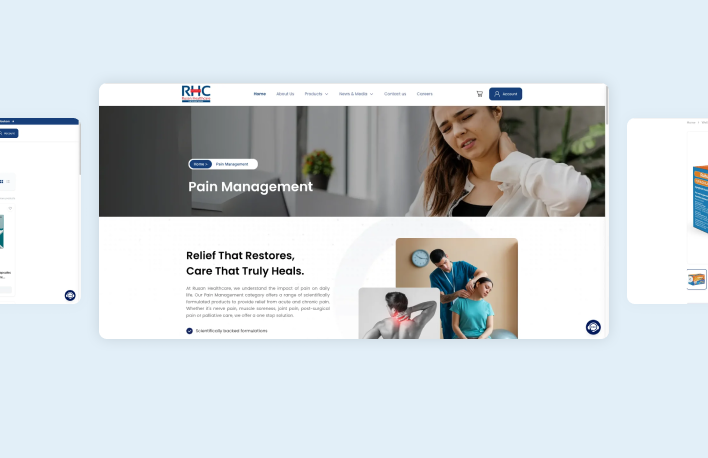
The category page shown below illustrates two of the website challenges. Pain Management has its own landing page with a breadcrumb, a hero image and descriptive copy about the products in that category. Pages like this needed to be indexable by search engines even though the products behind them come from ERP data, and the way products are described online had to respect pharmaceutical industry rules for product representation.
Website challenges
- Syncing thousands of pharmaceutical products from the ERP for accurate, real-time display.
- Keeping pages fast across India despite a large ERP-sourced product database.
- Optimizing dynamically generated product pages for search engines.
- Meeting pharmaceutical regulations for online product representation.
Distributor management system challenges
- Showing live stock availability from the ERP across multiple warehouses.
- Creating orders in the DMS that flow automatically into the ERP for fulfillment.
- Pulling tiered pricing from the ERP based on distributor category, volume and territory.
- Maintaining data integrity between the DMS and the ERP during synchronization.
- Managing permission levels for 500+ distributors, internal staff and administrators.
- Providing cached product and inventory data for distributors in remote areas with poor connectivity.
- Onboarding distributors with varying levels of technical proficiency.
Integration and technical challenges
- Bi-directional sync: portal orders must reach the ERP, and ERP product and inventory changes must reach the portal quickly.
- Mapping ERP data structures to user-friendly formats on the website and portal.
- Keeping the experience working when the ERP is temporarily unavailable.
- Querying and caching thousands of products without slow load times.
- Creating one cohesive experience across the public website and the distributor portal.
04 / The project
Public website with an ERP-synced product catalog
Ackrolix delivered a dual-platform solution: a public website and a distributor management system, both integrated with Rusan's existing ERP for catalog, inventory and order data. The public website is built with Next.js server-side rendering and ERP data caching, so pages load quickly and product content is available to search engines.
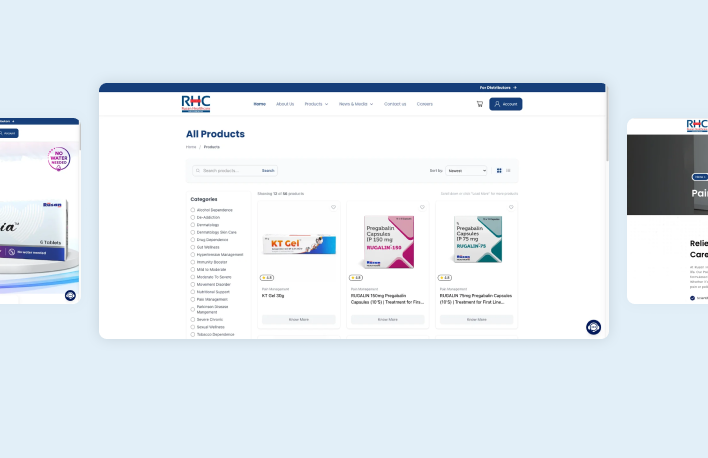
The All Products page shown below is the core of the catalog experience. Visitors can search products, sort results, switch between grid and list views and filter by therapeutic categories listed in a sidebar, including Pain Management, Movement Disorder, Parkinson Disease Management, De-Addiction and Nutritional Support. Each product card shows its category, name and a Know More link, and the page tells visitors to scroll or load more, so large result sets are delivered in batches rather than all at once.
- ERP-integrated product display with product information, therapeutic categories and specifications.
- Searchable, filterable catalog pulling live ERP data through an intelligent caching layer.
- Server-side rendering in Next.js for fast loads and SEO.
- CloudFront CDN delivery with cached product data across India.
- Mobile-first responsive design for healthcare professionals on any device.
- SEO architecture built to search engine guidelines.
05 / The project
Product pages, lead generation and marketing content
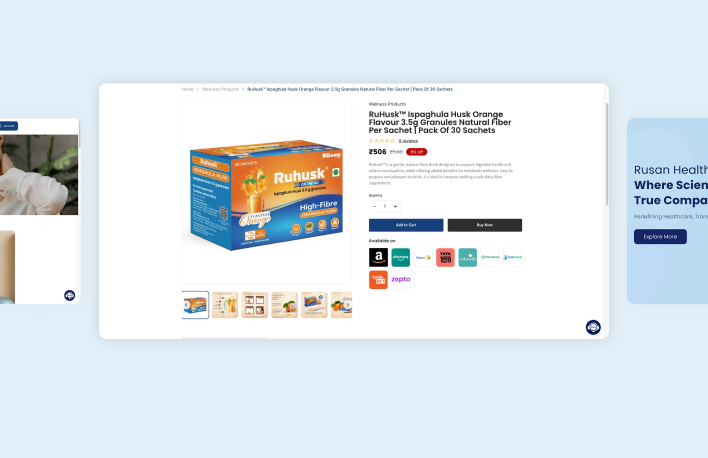
Each product has its own page built from synced product information. The RuHusk page shown below includes a breadcrumb back to its category, a product title, a short description, an image gallery with thumbnails, a quantity selector with Add to Cart and Buy Now buttons, and an "Available on" panel linking to online pharmacies and marketplaces where the product can be bought. The page also surfaces pricing and review information.
Around the catalog, the website includes strategic inquiry forms, distributor application forms and contact mechanisms, so hospitals, healthcare institutions and prospective distributors can reach Rusan directly. A custom-built CMS lets the marketing team update website content, promotional banners and announcements, while product data continues to update automatically from the ERP.
- Product detail pages with descriptions, images and specifications drawn from the ERP-synced catalog.
- Inquiry and distributor application forms for lead generation.
- Custom CMS for non-ERP content such as banners, news and announcements.
- A separate document management system for certificates, marketing materials and training documents.
06 / The project
Distributor management system for Rusan's network
The DMS gives distributors a secure, self-service view of the ERP. Distributors no longer need to learn or log into the ERP itself; instead they work in a portal designed around their daily tasks: checking stock, confirming their pricing, placing orders and tracking them.
Internal teams use a separate set of admin tools to onboard distributors, manage orders, monitor ERP synchronization and communicate with the network. The distributor portal itself is behind a login and is not pictured in this case study.
Distributor portal features
- Secure, role-based login with multi-factor authentication for sensitive data.
- Personalized dashboard with sales performance, pending orders and real-time notifications.
- ERP-synced catalog with live product information, specifications and images.
- Pricing pulled automatically from the ERP based on distributor tier.
- Stock availability across warehouses, synchronized from the ERP every 15 minutes.
- Online ordering with a cart that creates orders directly in the ERP.
- Order tracking with ERP-synced statuses: pending, approved, shipped and delivered.
- Document library for product catalogs, safety data sheets, certificates of analysis and marketing materials.
- Visibility of assigned territories and exclusive product rights.
- Communication center for queries, support requests and announcements.
- Sales reports and product-wise performance metrics sourced from ERP data.
Admin and internal management features
- Distributor onboarding, profile management and territory assignment, synced with the ERP.
- Order management with automatic sync to the ERP for fulfillment.
- ERP sync monitoring dashboard with last sync status, consistency checks and error handling.
- Content management for website content, promotional banners and distributor announcements.
- Analytics on distributor performance and product trends using ERP data.
- Announcements and notifications targeted to distributor segments.
- Audit logs of all system activity for compliance and security.
07 / The project
How did Ackrolix integrate the existing ERP?
Ackrolix built an integration layer between the ERP and the new platforms instead of changing the ERP. RESTful APIs connect the DMS with the ERP in both directions, and middleware translates ERP data structures into formats the website and portal can display.
Product and inventory data are synchronized every 15 minutes, while new orders are pushed to the ERP immediately. Redis caches ERP data so pages stay fast and the ERP is not queried on every request. If the ERP is temporarily unavailable, users are served cached data and failed syncs are retried from a queue. For critical changes such as inventory alerts and price updates, ERP webhooks trigger immediate updates in the DMS.
- ERP to DMS: product catalog, inventory levels, pricing and order status updates.
- DMS to ERP: new distributor orders and distributor profile updates.
- Real-time monitoring and alerting for integration health and data consistency.
- Progressive Web App capabilities for offline access to cached product data.
- AWS auto-scaling infrastructure, end-to-end encryption, role-based access control and secure API endpoints.
Distributor order flow
- The distributor signs in to the portal with role-based authentication and MFA.
- The distributor browses the ERP-synced catalog and sees tier-based pricing and warehouse stock.
- Products are added to the cart and the order is submitted.
- The order is pushed to the ERP immediately for approval and fulfillment.
- Status changes in the ERP (approved, shipped, delivered) are synced back to the portal for tracking.
- Order confirmations and notifications are sent by email through AWS SES.
Data synchronization flow
- Every 15 minutes, product and inventory data is pulled from the ERP.
- The transformation layer maps ERP records into website and portal formats.
- Data is cached in Redis and served to the website, portal and CDN.
- Critical ERP changes trigger webhooks for immediate updates.
- If a sync fails, cached data stays live and the sync is queued for retry while monitoring raises an alert.
08 / The project
Team, timeline and methodology
A 12-person Ackrolix team delivered the project over 10 months. ERP integration development ran in parallel with DMS development, and the rollout moved from a pilot with selected distributors to a full production launch.
The team followed Agile Scrum with two-week sprints, 20 sprints in total, and held regular integration meetings with Rusan's IT team to keep the ERP work aligned.
- Discovery and requirements analysis: 6 weeks.
- ERP integration planning and API documentation: 4 weeks.
- Design and prototyping: 5 weeks.
- Website development: 10 weeks.
- DMS development: 14 weeks.
- ERP integration development: 12 weeks, in parallel with DMS development.
- Integration testing and data validation: 5 weeks.
- User acceptance testing: 3 weeks.
- Distributor training and onboarding: 4 weeks.
- Pilot launch with selected distributors: 2 weeks.
- Full production launch and stabilization: 3 weeks.
- Methodology: CI/CD pipeline with continuous integration and automated testing, weekly stakeholder reviews and demos, bi-weekly ERP integration meetings with the IT team, monthly distributor beta testing sessions and a phased pilot-to-full rollout.
| Role | Count | Responsibility |
|---|---|---|
| Business Analyst | 1 | Requirements gathering, ERP integration analysis, distributor workflow mapping |
| Project Manager | 1 | Project coordination, timeline management, stakeholder communication |
| Frontend Developers | 3 | React.js/Next.js development, UI for the website and DMS portal |
| Backend Developers | 3 | Node.js APIs, ERP integration layer, data synchronization logic |
| QA Engineer | 1 | Testing of the website, DMS functionality, ERP integration and security |
| DevOps/Cloud Engineer | 1 | AWS infrastructure, deployment, ERP connectivity, monitoring |
| UI/UX Designers | 2 | Website design, distributor portal UX, mobile optimization |
09 / The project
Technology stack
The platform uses a microservices-oriented architecture with a dedicated integration layer for ERP connectivity. MongoDB stores data owned by the platform, such as distributor profiles, orders and user accounts, while Redis caches ERP data and sessions.
| Layer | Technologies |
|---|---|
| Frontend | React.js, Next.js, HTML5, CSS3, JavaScript (ES6+) |
| Backend | Node.js, Express.js, RESTful APIs |
| Database | MongoDB (distributor data, orders, user profiles), Redis (ERP data caching, session management) |
| ERP integration | RESTful API integration, webhooks, data transformation middleware |
| Cloud infrastructure | AWS EC2, Elastic Load Balancer, Auto Scaling Groups, CloudFront CDN, S3 |
| Authentication | JWT tokens, OAuth 2.0, multi-factor authentication (MFA) |
| Architecture | Microservices-oriented with an integration layer for ERP connectivity |
| Security | SSL/TLS encryption, role-based access control (RBAC), AWS WAF, secure API authentication |
| Caching and performance | Redis (ERP data caching), CDN caching, database indexing |
| Integration monitoring | Custom sync monitoring dashboard, error logging, retry queues |
| File management | AWS S3 for document storage, CloudFront for secure document delivery |
| Email services | AWS SES for order confirmations, notifications and announcements |
| DevOps | CI/CD pipeline, Docker, automated deployment, CloudWatch monitoring |
| CMS | Custom-built admin dashboard for non-ERP content |
| Analytics | Google Analytics, custom analytics dashboard combining ERP and platform data |
10 / The project
What results did Rusan Healthcare see?
The figures below come from Ackrolix's project documentation and describe the documented period after launch. They are project-reported results, not independent benchmarks.
Business growth
The project documentation reports 150+ new distributors onboarded within six months of launch, a 45% increase in qualified business inquiries from hospitals and healthcare institutions, and a threefold increase in organic traffic after ERP-synced product pages improved search rankings. It also records an 89% distributor satisfaction score with the new portal.
ERP integration
- Reported 99.7% successful sync rate between the DMS and the ERP.
- All DMS orders reported as transferred to the ERP for fulfillment.
- No data duplication: the ERP remained the single source of truth.
- Average 15-minute inventory sync cycle with instant order submission.
- Reported 85% reduction in ERP API calls through caching.
Operational efficiency
- Reported 70% reduction in average order processing time, from 48 hours to 14 hours.
- No manual product data entry; catalog information is pulled from the ERP.
- Reported 90% reduction in distributor calls about stock availability.
- Order approval and ERP submission automated.
- Sales team reported to save 20+ hours per week on distributor support and order management.
Performance
- Page load time reported at 1.5 seconds, 60 to 70% faster, using Next.js SSR and ERP data caching.
- Reported 99.9% uptime on AWS with failover during ERP maintenance.
- Auto-scaling handled reported 5x traffic increases during product launches.
- The system continues working with cached data when the ERP is temporarily unavailable.
Distributor management and experience
- 500+ active distributors onboarded to the digital platform.
- 75% of distributors reported actively ordering through the portal within the first three months.
- 94% of distributors reported high confidence in stock availability accuracy.
- Reported 95% reduction in order errors compared with manual entry.
- Average order-to-shipment time reported to fall from 3 days to 1.5 days.
- 80% of product and pricing queries reported as resolved through the portal without contacting support.
- Advanced catalog search lets distributors find products in under 30 seconds.
Revenue impact
- Reported 35% increase in monthly order volume.
- Reported 22% increase in average order value, attributed to better product discovery.
- Order fulfillment rate reported to improve by 18% through real-time inventory visibility.
- Payment collection reported to improve by 18% through digital order documentation.
- Reported expansion into 8 new states with ERP-connected operations.
Scalability and future readiness
The integration layer is designed so that future ERP upgrades do not require re-architecting the DMS. The modular design leaves room for accounting and logistics integrations, analytics that combine ERP and platform data, and a possible future B2C eCommerce channel using the same ERP integration.
11 / The project
Why the Rusan Healthcare project matters
Rusan Healthcare now runs a public website and a distributor management system on top of its existing ERP. The ERP remains the single source of truth, and the new interfaces make its catalog, pricing, stock and order data usable by distributors, marketing and internal teams who never need to log into it.
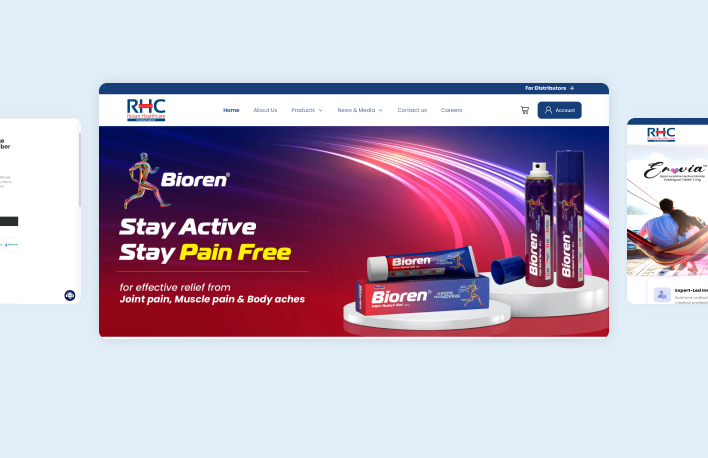
The Bioren homepage banner shown below is part of that professional public presence. It promotes the Bioren pain relief range with a bold "Stay Active, Stay Pain Free" headline and product imagery of a spray and gel, under the same navigation and For Distributors entry point used across the site. Brand content like this is managed through the CMS, while product information stays tied to the ERP.
The broader lesson is that a business does not need to replace a working ERP to modernize. A well-designed integration layer, caching and monitoring can put a modern, mobile-friendly experience in front of the system that already runs the business, and give Rusan a foundation for further growth.
- ERP data made accessible through web and mobile interfaces, with 24/7 self-service access to inventory and pricing.
- Distributors no longer need direct ERP access.
- A professional digital presence with current product information.
- A base for future integrations and channels without replacing core business systems.
The Impact
- 99.7%
- Reported ERP sync success
- 70%
- Reported order processing reduction
Technology used
Questions about this project
What did Ackrolix build for Rusan Healthcare?
Ackrolix built a public pharmaceutical website and a distributor management system with admin tools, both connected to Rusan's existing ERP for product catalog, pricing, inventory and orders. The website includes a searchable catalog, category and product pages, inquiry forms and a custom CMS.
Did the project replace Rusan's ERP?
No. The ERP remained the single source of truth. Ackrolix added an integration layer with RESTful APIs, webhooks and data transformation middleware, and built the website and distributor portal on top of it.
How current is the inventory and pricing data distributors see?
Product and inventory data is synchronized from the ERP every 15 minutes, and ERP webhooks push critical changes such as price updates and inventory alerts immediately. Orders placed in the portal are sent to the ERP right away.
What happens if the ERP is temporarily unavailable?
The website and portal keep serving data from the Redis cache, failed syncs are placed in a retry queue, and a monitoring dashboard alerts the team to integration problems.
How long did the project take and what team was involved?
The project took 10 months with a 12-person team: a business analyst, a project manager, three frontend developers, three backend developers, a QA engineer, a DevOps/cloud engineer and two UI/UX designers, working in two-week Agile sprints.
Which technologies were used?
React.js and Next.js on the frontend, Node.js and Express.js on the backend, MongoDB and Redis for data and caching, and AWS services including EC2, auto scaling, CloudFront, S3, SES, WAF and CloudWatch, with JWT, OAuth 2.0 and MFA for authentication.
Prepared by Ackrolix Innovations from its development portfolio, pages 4, 5, 6, 7, 8, 9, 10, 11, 12, 13, 14. Reported results relate to the documented project period. About the team.