01 / The client
About Praeferre and the website engagement
Praeferre is a Governance, Risk and Compliance (GRC) company working across AI-powered compliance, cybersecurity and data privacy. Its B2B model serves enterprises that need to manage data privacy, security and regulatory obligations, and its positioning treats privacy as a trust obligation rather than a checkbox exercise.
Praeferre came to Ackrolix Innovations for a premium, enterprise-grade website that would reflect its AI-driven approach and build credibility in a competitive GRC market. The scope of this engagement was the website and marketing platform: brand presentation, product and service pages, content, lead capture and the technical foundation behind them.
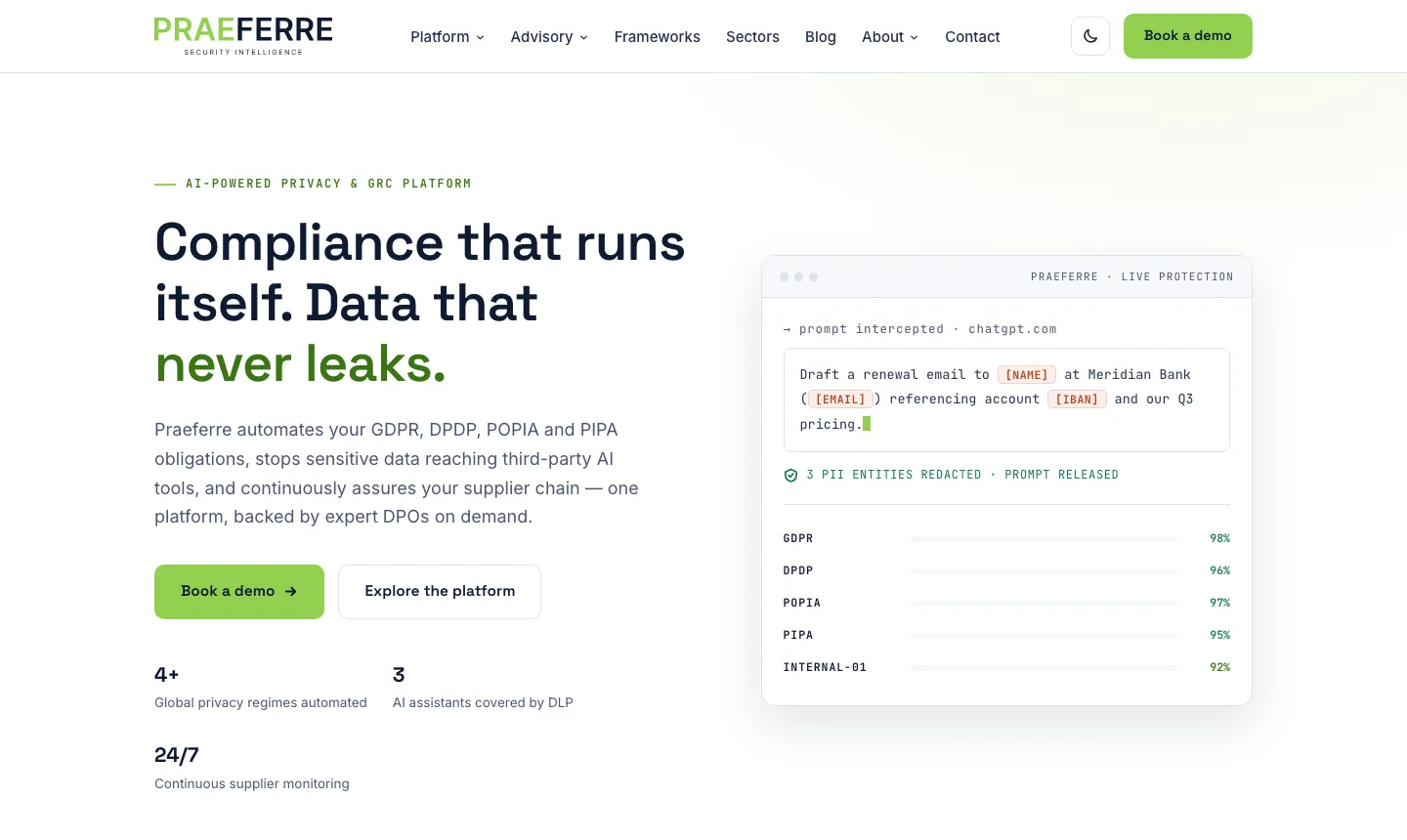
The homepage hero shown below is how the live site introduces the company today. A headline reading "Compliance that runs itself. Data that never leaks." sits beside a short summary of GDPR, DPDP, POPIA and PIPA automation, AI data protection and supplier assurance. Two calls to action, "Book a demo" and "Explore the platform", give sales-ready visitors and early researchers separate next steps, and a mock "live protection" panel illustrates a redacted AI prompt next to framework status bars.
- Industry
- Cybersecurity & Compliance
- Services / expertise
- GRC Website Development · B2B SaaS Website · Enterprise Website Development
- Business model
- B2B enterprise compliance platform (AI-powered GRC, cybersecurity and privacy)
- Platforms
- Enterprise marketing website, desktop and mobile, on Next.js and Vercel
- Team size
- 23 professionals
- Duration
- 8 months
- Client website
- Visit Praeferre ↗
Planning a similar project? Explore our website design and development services.
02 / The project
What did Praeferre need from its enterprise website?
The requirement went beyond a brochure site. Praeferre needed a platform that could speak to technical evaluators and business leaders at the same time, generate and nurture enterprise leads across long sales cycles, and demonstrate technical credibility through its own build quality.
Ackrolix's project documentation groups the requirement into five areas.
Enterprise website and brand positioning
The site had to establish Praeferre as an innovator in AI-driven GRC and compliance automation, with a sophisticated visual experience that matched the quality of its products.
- Dual-audience messaging for technical decision-makers (CISOs, CTOs) and business leaders (CEOs, CPOs, legal teams).
- A clear product portfolio showcase that differentiates four core products.
- Visibility for consulting and transformation services alongside the products.
- Trust signals covering regulatory frameworks and enterprise security standards.
Lead generation and sales enablement
Enterprise and mid-market buyers rarely convert on a first visit, so the site needed to support multi-touch nurturing.
- Qualified lead capture from enterprise prospects.
- Streamlined product demo requests.
- Gated whitepapers, case studies and guides for lead qualification.
- Attribution of the customer journey from awareness to conversion.
Content and thought leadership
Praeferre wanted a publishing base for regulatory updates and expertise.
- A regulatory intelligence hub for compliance updates and industry insight.
- Blog and insights content.
- Whitepapers, webinars and best-practice guides.
- Client case studies and event promotion.
Technical credibility and documentation
Technical evaluators and integration partners needed depth, not just marketing copy.
- API documentation for evaluators and partners.
- A place to present security and compliance certifications.
- An integration ecosystem showcase.
- High-level system architecture for enterprise IT teams.
Performance and global reach
The site had to load quickly for international prospects, work fully on mobile for traveling executives, support search visibility for GRC, compliance and privacy keywords, and follow security best practices itself.
03 / The project
Challenges in marketing a GRC platform to enterprise buyers
Praeferre was a newer entrant competing with established GRC vendors, and its products are technically complex. The website had to simplify that complexity without diluting it, and it had to support evaluations that the documentation describes as running six to twelve months.
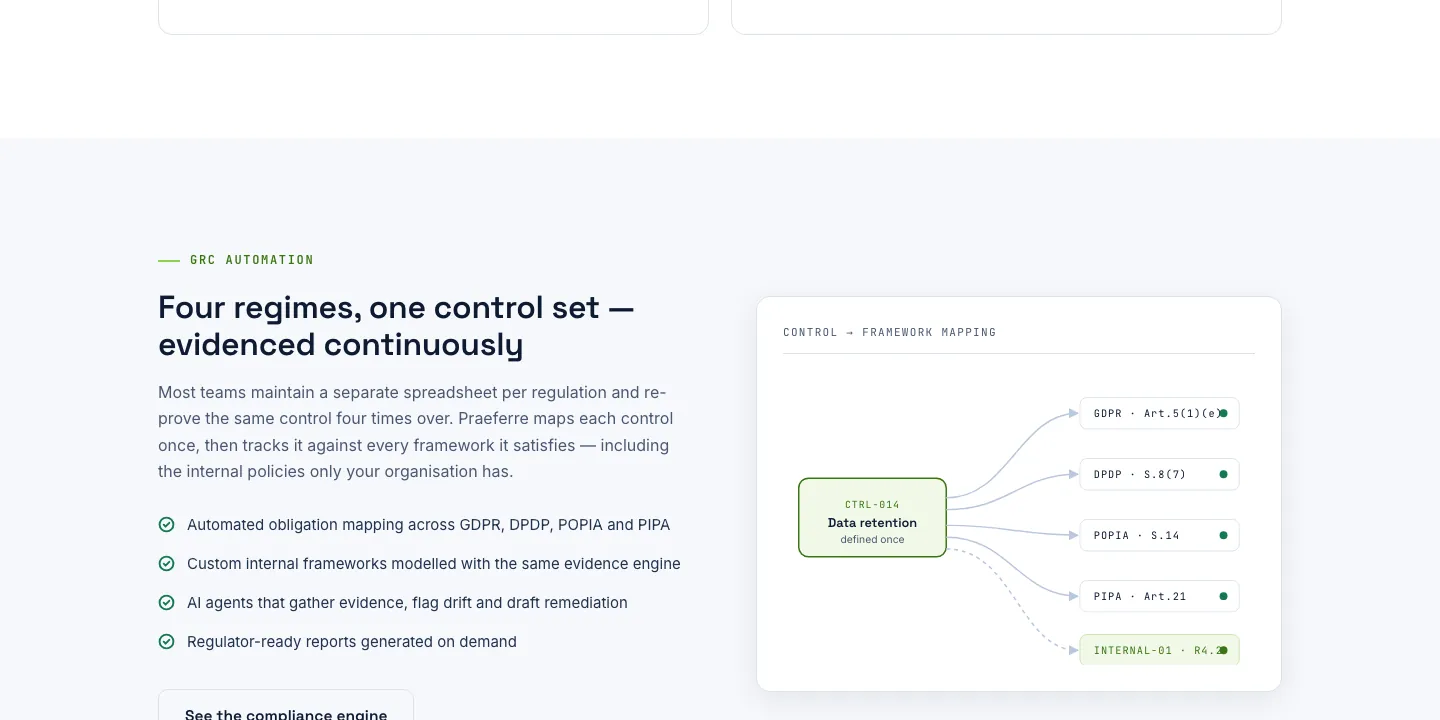
Regulatory complexity is a good example of how the site handles this today. The GRC automation section shown below explains, in one headline and one diagram, that a single control such as data retention is defined once and mapped to GDPR, DPDP, POPIA, PIPA and an internal framework. Four short checklist points then cover obligation mapping, custom frameworks, AI evidence gathering and regulator-ready reports, so a visitor grasps the idea without reading regulation text.
Brand and positioning
- Standing out in a crowded GRC market against established vendors.
- Substantiating AI-driven claims with real technical depth rather than buzzwords.
- Building trust as a newer entrant.
- Balancing technical depth for security engineers with a business case for executives.
Content and communication
- Explaining agentic AI systems to non-technical compliance professionals.
- Clear navigation between four overlapping products.
- Covering diverse global regulations without overwhelming visitors.
- Detailed specifications alongside accessible business messaging.
Enterprise sales
- Sustained engagement through long procurement processes.
- Content for security, legal, IT, procurement and executive personas.
- Demonstrating compliance efficiency gains and risk reduction.
- Supporting feature comparison during competitive evaluation.
Technical, performance and SEO
- Fast responses for technical audiences in Europe, Asia and the Americas.
- Website security that reflects the company's compliance expertise.
- Full mobile feature parity for executives.
- Multi-touch attribution across months-long sales cycles.
- Competitive keywords, technical SEO for dynamic Next.js pages, regular fresh content and a relatively new domain.
04 / The project
How did Ackrolix organize Praeferre's products on the website?
Ackrolix designed and developed the website on Next.js 16 with Vercel edge infrastructure. The homepage experience in the documentation includes an animated gradient hero, a four-product showcase with hover previews and GSAP transitions, trust indicators, social proof and a dual call-to-action strategy: "Book Demo" for sales-ready prospects and "Download Resources" for early-stage researchers.
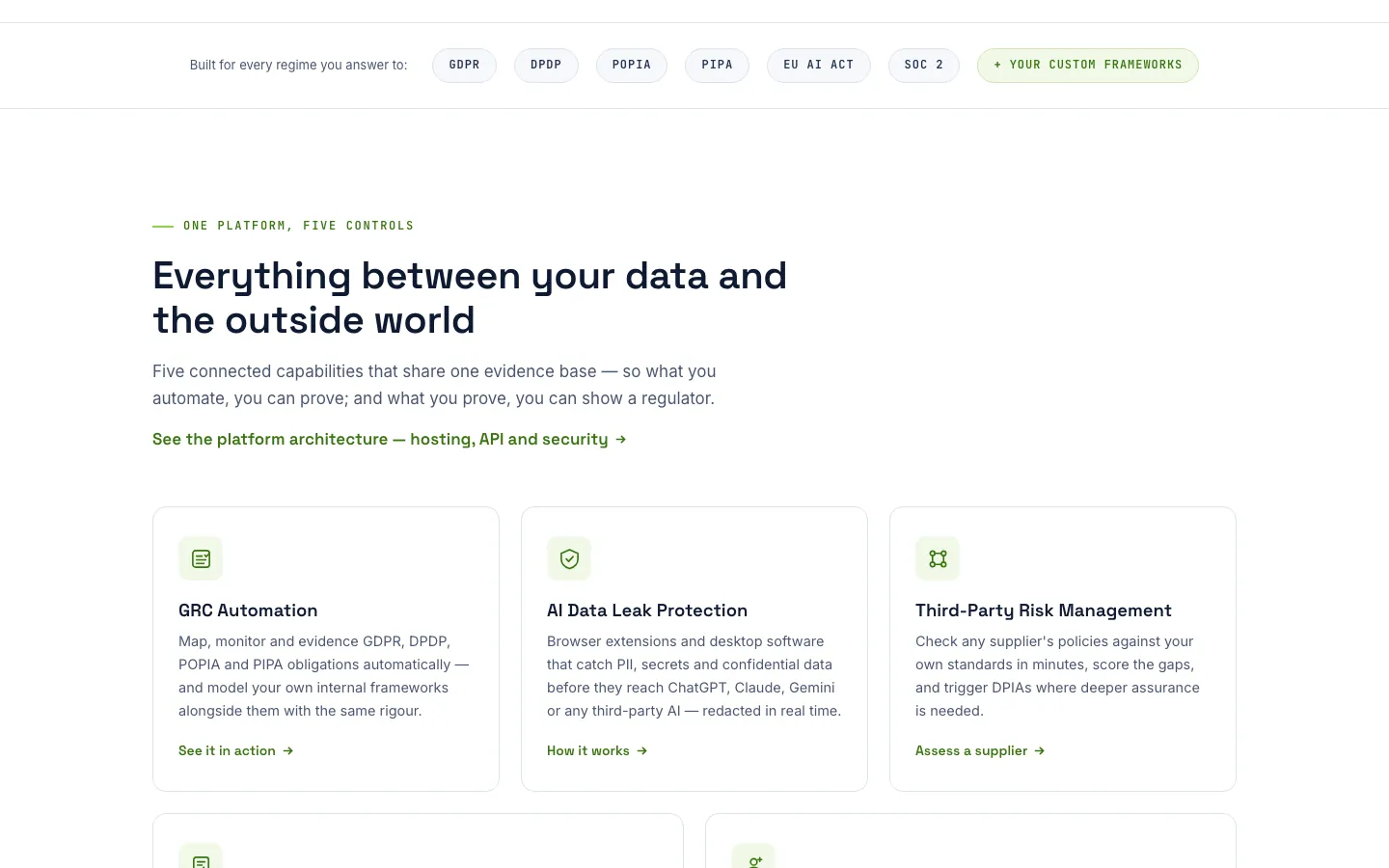
The platform overview below shows how the live site separates the offering today. A strip of regime tags (GDPR, DPDP, POPIA, PIPA, EU AI Act, SOC 2 and custom frameworks) sits above a section headed "One platform, five controls". Cards for GRC Automation, AI Data Leak Protection and Third-Party Risk Management each carry a one-paragraph description and their own link, with a link to the platform architecture page for technical readers. The live product names and count differ from the four products listed in the project documentation, which reflects how Praeferre's offering has evolved since the build.
- Distinct card per product with its own call to action, reducing confusion between overlapping offerings.
- Regime tags that let a visitor confirm coverage at a glance.
- A dedicated route to hosting, API and security detail for IT evaluators.
- Top navigation for Platform, Advisory, Frameworks, Sectors, Blog, About and Contact, with a persistent "Book a demo" button.
05 / The project
Product pages for AI-driven GRC and AI security
The project documentation specifies a dedicated page for each core product, built to carry both executive messaging and technical depth. The Agentic GRC page covers AI automation capabilities, interactive demonstrations, an integration showcase and an ROI calculator. The AI Security and Governance page covers security framework mapping, compliance dashboard previews and technical architecture diagrams.
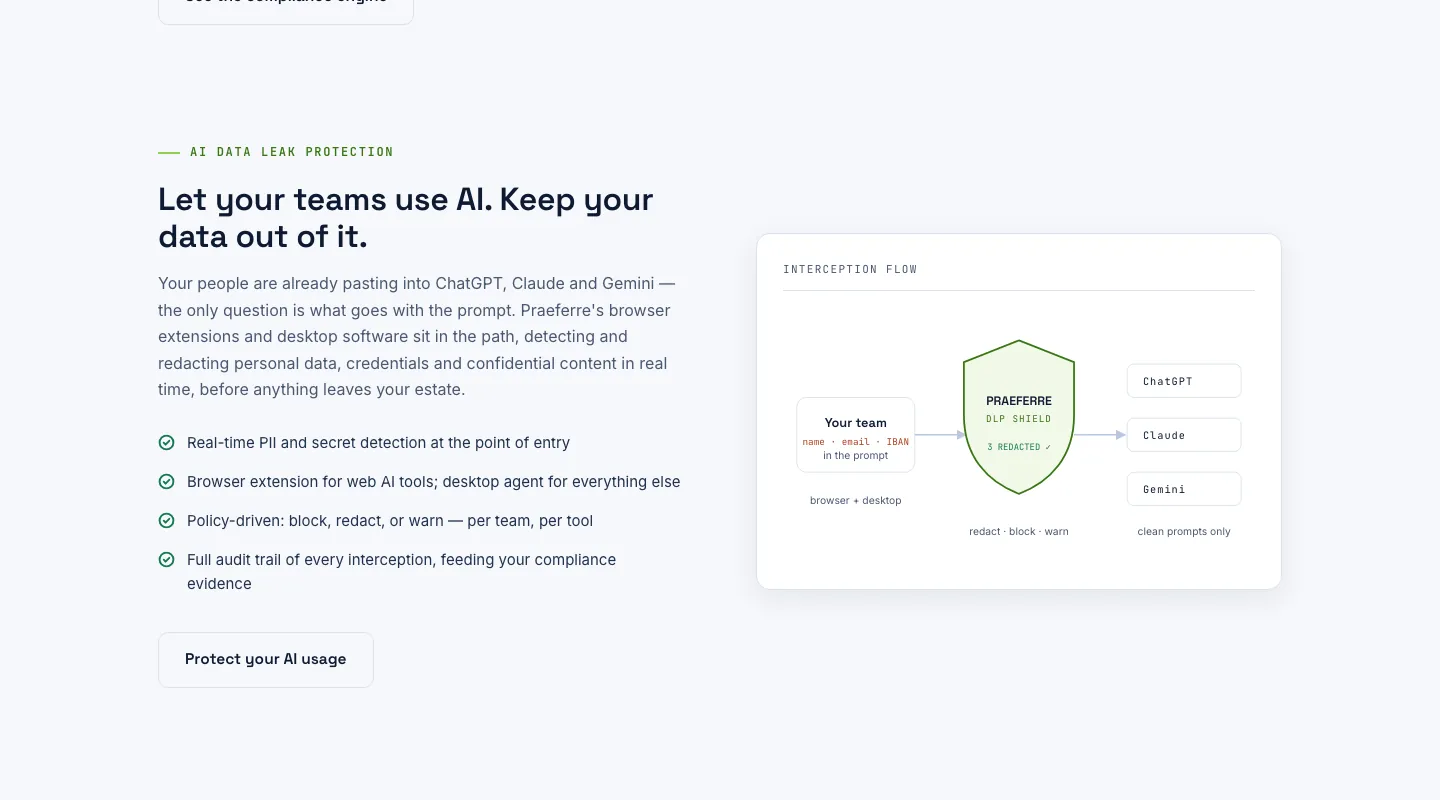
The AI data leak protection section below shows the pattern on the live site. A short problem statement about staff pasting into ChatGPT, Claude and Gemini leads into four capability points: real-time detection, browser and desktop coverage, policy-driven block, redact or warn actions, and a full audit trail. On the right, an interception-flow diagram traces a prompt from "Your team" through a Praeferre DLP shield to the AI tools, which explains the product visually before a visitor reaches the "Protect your AI usage" button.
Agentic GRC page
- Feature breakdown with interactive demonstrations.
- AI automation capabilities and integration showcase.
- ROI calculator for business case building.
AI Security and Governance page
- Security framework mapping.
- Compliance dashboard previews.
- Technical architecture diagrams for IT teams.
06 / The project
Presenting third-party risk and privacy management
Two further product pages were in the documented scope. The Third-Party Risk Management page explains the vendor assessment workflow, continuous monitoring and risk scoring methodology. The Universal Privacy Management page covers a multi-regulation compliance matrix, data mapping features and consent management.
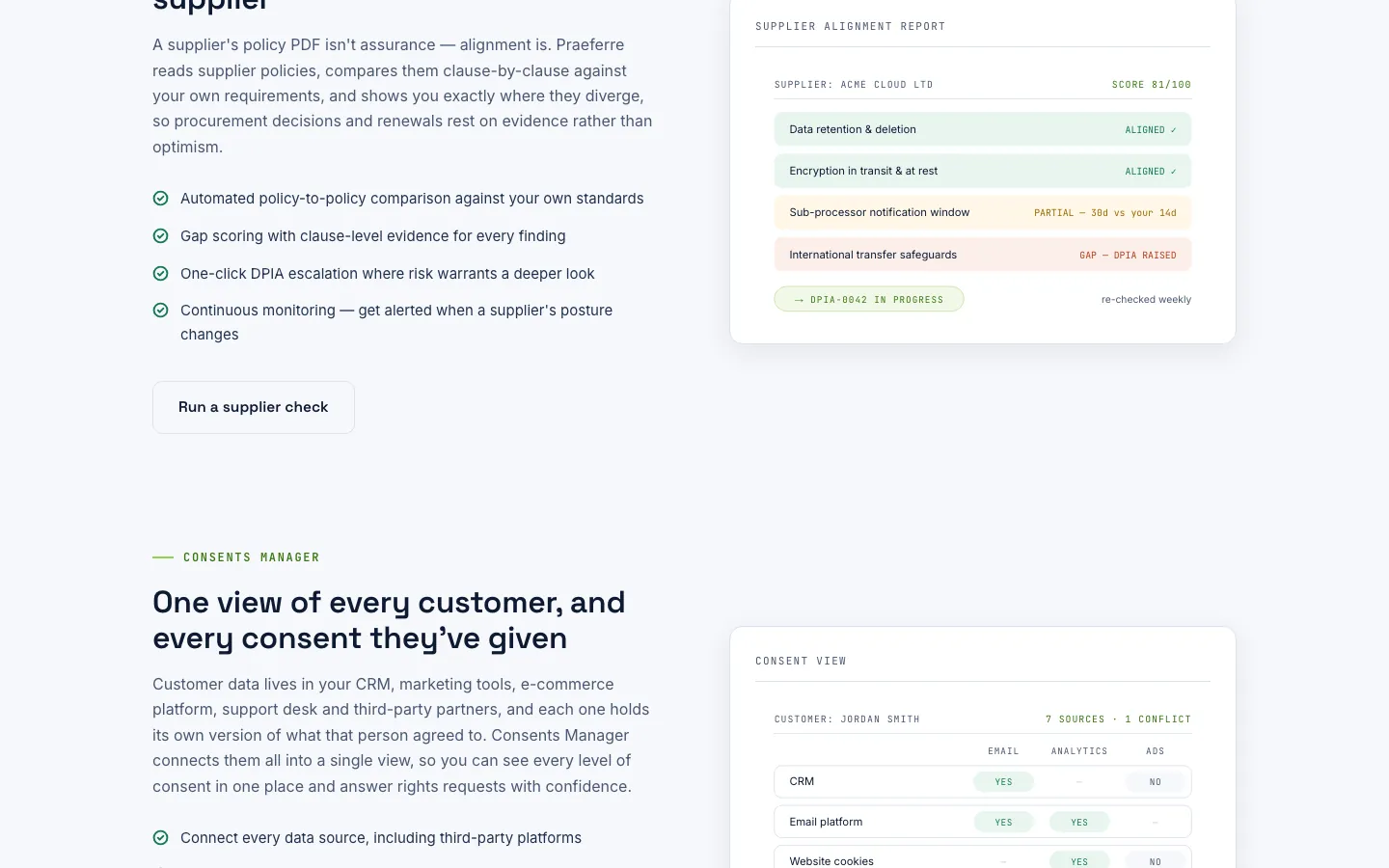
The screenshot below shows how those topics appear on the live site. The supplier section lists automated policy comparison, clause-level gap scoring, DPIA escalation and continuous monitoring, next to a sample supplier alignment report that marks each clause as aligned, partial or a gap. Below it, the Consents Manager section explains how consent records from a CRM, email platform and website cookies are brought into one customer view, with a sample consent table illustrating sources and conflicts.
- Problem-first copy followed by four scannable capability points per product.
- Sample report visuals that show the output a buyer would receive.
- A dedicated call to action per product, such as "Run a supplier check".
07 / The project
Services, resources and lead-generation features
Alongside the products, the site gives Praeferre's service lines their own space. The documentation lists services pages for transformation services, AI strategy, workforce transformation and advisory services, each describing methodology, deliverables or engagement models.
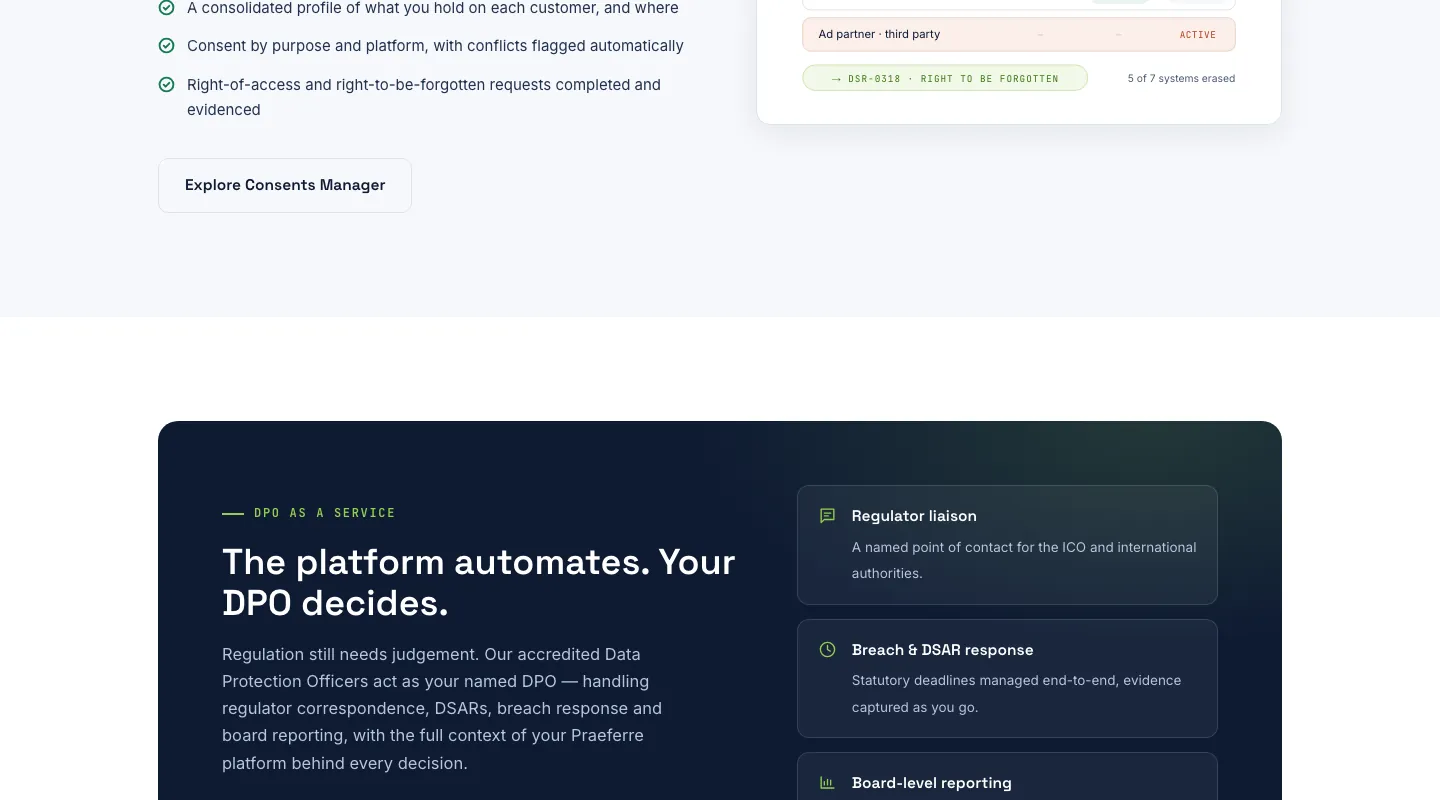
The DPO-as-a-service panel below is one example of service messaging on the live site. A dark full-width block headed "The platform automates. Your DPO decides." explains that accredited Data Protection Officers act as the client's named DPO, and a column of cards lists regulator liaison, breach and DSAR response, and board-level reporting. This connects the human service to the software, which supports the requirement to make services visible next to the product offering.
Content and resources hub
The documented hub supports long B2B buying cycles with material for each stage.
- Regulatory intelligence center filterable by regulation type, geography and industry.
- Blog and insights optimized for search and social sharing.
- Resource library with gated whitepapers, compliance guides and webinar recordings.
- Case studies, webinars and events, and a searchable compliance glossary.
Interactive tools and conversion paths
Interactive features help prospects qualify themselves and build an internal business case.
- Compliance assessment quiz that generates a custom maturity report.
- ROI calculator with downloadable PDF output.
- Product comparison feature matrix.
- Demo scheduler with calendar integration.
- Live chat with AI-assisted initial triage and escalation to a person.
08 / The project
Trust and credibility sections for security-conscious buyers
Enterprise buyers in privacy and security look for evidence before they engage. The documented scope included sections for security and compliance documentation, an integration marketplace showing connections to enterprise systems such as Slack, Jira and ServiceNow, an API documentation hub, video and written testimonials, and industry recognition.
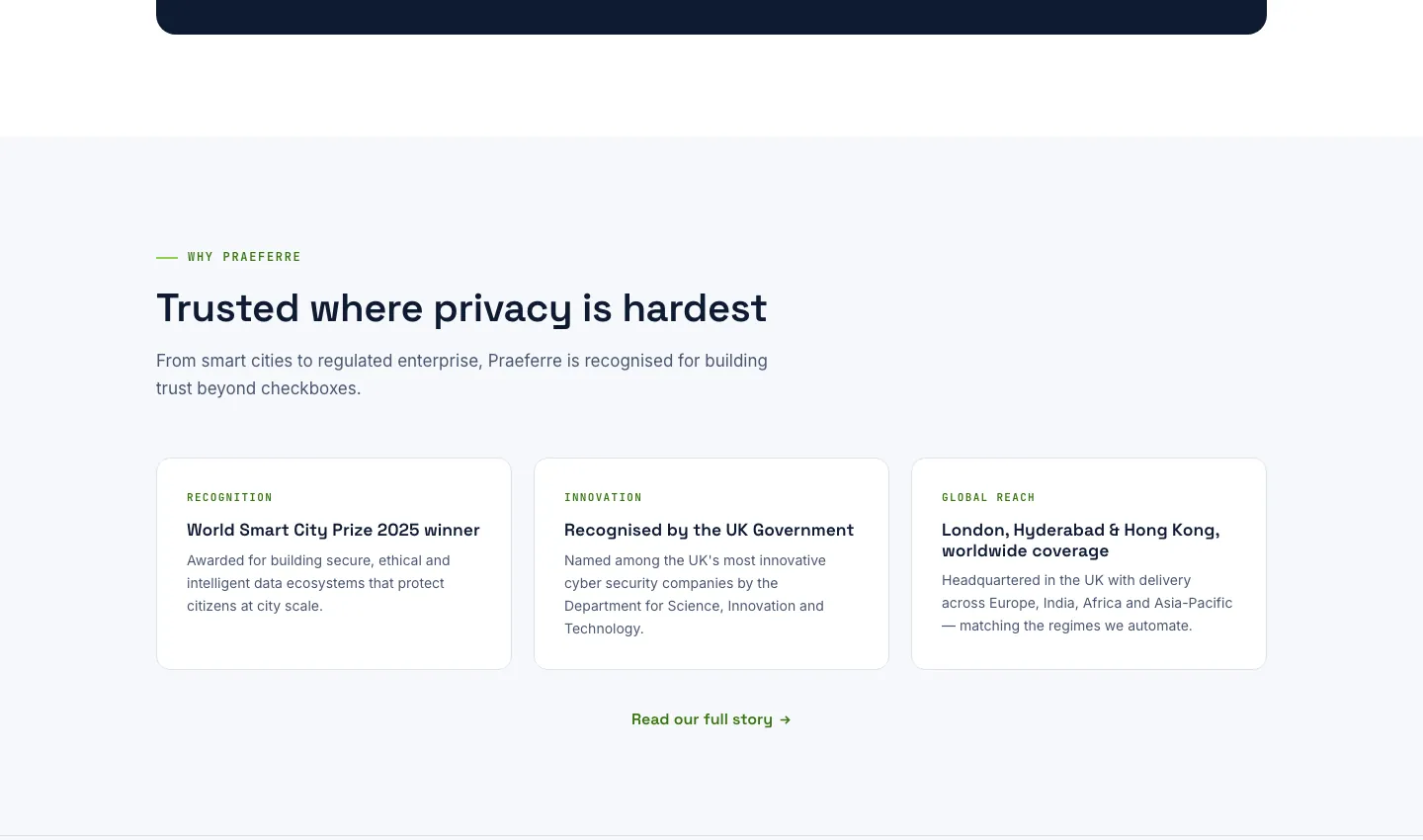
The recognition block below shows how the live site presents this today. Under the heading "Trusted where privacy is hardest", three cards present Praeferre's own claims: a World Smart City Prize 2025 win, recognition by the UK Department for Science, Innovation and Technology, and offices in London, Hyderabad and Hong Kong.
09 / The project
Which technologies power the Praeferre website?
The technical foundation was chosen to support fast global delivery, search visibility and security practices that match Praeferre's market. Next.js 16 combines server-side rendering for dynamic, profile-based content, static generation for blogs and resources, and incremental static regeneration so content can be refreshed without full rebuilds.
Vercel provides edge delivery, serverless functions, automatic HTTPS and image optimization. The design system uses Tailwind CSS, GSAP micro-interactions, Lenis smooth scrolling, Lucide icons and priority hints for critical resources.
- SEO: Open Graph previews, Schema.org structured data, XML sitemaps, custom meta titles and descriptions, and canonical URLs.
- Security: HSTS, security headers (CSP, X-Frame-Options, X-Content-Type-Options), Vercel DDoS mitigation and encryption in transit.
- Analytics: Google Analytics 4, Google Tag Manager, Microsoft Clarity heatmaps and session recordings, and custom multi-touch lead attribution from first visit to demo request.
- Backend: Node.js and Vercel serverless functions handling APIs, forms and CRM integration.
| Layer | Technologies |
|---|---|
| Frontend framework | React.js, Next.js 16 |
| Rendering strategy | SSR, SSG and ISR |
| Hosting and delivery | Vercel edge network, serverless functions, automatic scaling |
| Styling and UI | Tailwind CSS, GSAP, Lenis, Lucide icons |
| Performance | Priority hints, Next.js Image component with automatic WebP conversion |
| Backend | Node.js, Vercel Serverless Functions |
| Data | PostgreSQL (leads, contacts), Vercel KV (edge caching) |
| CRM and email | HubSpot/Salesforce API integration, SendGrid, Resend |
| Forms | React Hook Form with server-side validation |
| Content management | Headless CMS for blog and resources |
| Analytics and tags | Google Analytics 4, Microsoft Clarity, Google Tag Manager |
| SEO and security | Open Graph, structured data, HSTS and security headers |
| Monitoring | Vercel Analytics, Sentry |
10 / The project
Team, timeline and delivery methodology
Ackrolix staffed the project with a 23-person team covering strategy, design, engineering, content and SEO, and delivered it over eight months. Content development and backend integration ran in parallel with design and frontend work.
The team worked in two-week Agile Scrum sprints with regular stakeholder, content and SEO reviews.
- Discovery and competitive analysis: 4 weeks.
- Brand strategy and messaging: 3 weeks.
- UX/UI design for desktop and mobile: 6 weeks.
- Content development: 8 weeks, in parallel with design and development.
- Frontend development on Next.js 16: 12 weeks.
- Backend and integrations: 6 weeks, in parallel.
- SEO implementation: 4 weeks.
- Quality assurance and testing: 4 weeks.
- Content migration and population: 3 weeks.
- Soft launch and optimization: 2 weeks, followed by a 1-week full production launch.
- Methodology: 16 two-week sprints, weekly stakeholder reviews and design critiques, bi-weekly content reviews, monthly SEO audits, continuous Vercel deployment, A/B testing on conversion points and quarterly analytics sessions.
| Role | Count | Responsibility |
|---|---|---|
| Business Analyst | 2 | Requirements gathering, competitive analysis, messaging strategy |
| Project Manager | 1 | Timeline management, stakeholder coordination, delivery oversight |
| UI/UX Designer | 3 | Enterprise website design, product page UX, mobile optimization, animation design |
| Frontend Developer | 4 | Next.js 16 development, Tailwind CSS, GSAP animations, responsive implementation |
| Backend Developer | 3 | API development, serverless functions, CRM integrations |
| DevOps Engineer | 2 | Vercel deployment, performance optimization, monitoring setup |
| QA Engineer | 2 | Cross-browser testing, mobile testing, performance validation |
| Content Strategist | 3 | Messaging development, blog content, resource creation, SEO content |
| SEO Specialist | 1 | Keyword research, on-page optimization, technical SEO |
| Copywriter | 2 | Website copy, product descriptions, case studies |
11 / The project
Outcomes and impact for Praeferre
Ackrolix's project documentation reports outcomes across lead generation, positioning, performance and engagement.
The overall result is a website that acts both as a lead generation channel and as evidence of Praeferre's technical standards. Its modular Next.js architecture, headless CMS and edge deployment give the team room to add features, publish without developers and expand into new regions without re-architecting.
Lead generation and sales support
The documentation reports qualified enterprise and mid-market leads, a steady pipeline of demo requests and consultation inquiries, and better-informed prospects arriving at sales conversations because of self-service product information, case studies and interactive tools.
Positioning and thought leadership
Regular regulatory updates, a resource library and trust-focused messaging are reported to have strengthened Praeferre's position as an AI-driven GRC provider and differentiated it from checkbox-compliance messaging.
Performance and security practice
The project reports sub-second page loads and strong Lighthouse results at launch, globally distributed delivery through Vercel's edge network, an optimized mobile experience, and HSTS and security headers that demonstrate the security practices Praeferre advises on.
Engagement and search visibility
During the documented period, the project reports healthy session engagement, use of the assessment tool and ROI calculator, gated resource downloads, demo scheduling through the calendar integration, and growing organic visibility for GRC, compliance and privacy topics through ongoing content.
Scalability
Serverless functions, API-first design and a headless CMS mean new product pages, integrations and content can be added as Praeferre's offering evolves, as the live site's current product lineup shows.
Technology used
Questions about this project
Did Ackrolix build Praeferre's compliance software?
No. Ackrolix designed and developed Praeferre's enterprise website and marketing platform: brand experience, product and service pages, content and resources hub, lead capture, integrations and the technical foundation. Praeferre's GRC, data protection and supplier risk products are its own.
How long did the Praeferre website take and how large was the team?
The project ran for eight months with a 23-person team, including business analysts, a project manager, designers, frontend and backend developers, DevOps, QA, content strategists, an SEO specialist and copywriters. Work was organized into 16 two-week sprints.
What technology stack was used?
The site uses React and Next.js 16 with SSR, SSG and ISR, deployed on Vercel's edge network with serverless functions. Styling and motion use Tailwind CSS, GSAP and Lenis, with PostgreSQL and Vercel KV for data, a headless CMS for content and Sentry plus Vercel Analytics for monitoring.
Which integrations support lead generation?
The documented integrations include CRM API integration (HubSpot/Salesforce), SendGrid and Resend for email, React Hook Form with server-side validation, a calendar-based demo scheduler, and Google Analytics 4, Google Tag Manager and Microsoft Clarity for analytics and multi-touch attribution.
How does the website serve both technical and executive buyers?
Each product has its own page and card with plain-language messaging and diagrams, while technical readers get architecture, API documentation and security detail. Gated resources, an ROI calculator and a compliance assessment tool support different stages of a long B2B evaluation.
Prepared by Ackrolix Innovations from its development portfolio, pages 77, 78, 79, 80, 81, 82, 83, 84, 85, 86, 87. Reported results relate to the documented project period. About the team.