01 / The client
About Get My Rugs and the project
Get My Rugs sells handmade rugs online. Ackrolix's portfolio lists it as a rugs and home decor eCommerce store.
The live site describes hand-knotted, hand-tufted and hand-woven rugs in wool, silk and jute, made on the company's own looms in India. Prices are shown in US dollars, and the footer notes that rugs are shipped from a warehouse in South Carolina. The top bar also mentions the brand's founding year and its family weaving heritage.
Ackrolix's portfolio lists Get My Rugs as a Shopify eCommerce project for rugs and home decor products.
Rugs are a considered purchase. Shoppers need to compare size, color, pattern and material, and they want to picture a rug in their own room before buying. The live store addresses this with filter-led navigation, seasonal edits, a guided room finder and content about how the rugs are made. The sections below walk through those parts of the homepage.
- Shopify store for handmade rugs
- Navigation by size, color, pattern and category
- Merchandising sections for seasonal edits, best sellers and new arrivals
- Industry
- E-commerce & On-Demand
- Services / expertise
- Shopify eCommerce · Rugs and home decor · Shopify
- Client
- Get My Rugs
- Industry
- Rugs and home decor
- Service
- Shopify eCommerce store
- Platform
- Shopify
- Client website
- Visit Get My Rugs ↗
02 / The project
Seasonal edits that guide by color
The header is built around product discovery. The menu links to Sale, a price-capped range, All Rugs, Design Studio and Jute Rugs, with dropdowns for Categories, Size, Color and Pattern. A large search bar sits below it, with an example query, a camera icon and an option to ask in plain words. Rewards, account and cart icons complete the header.
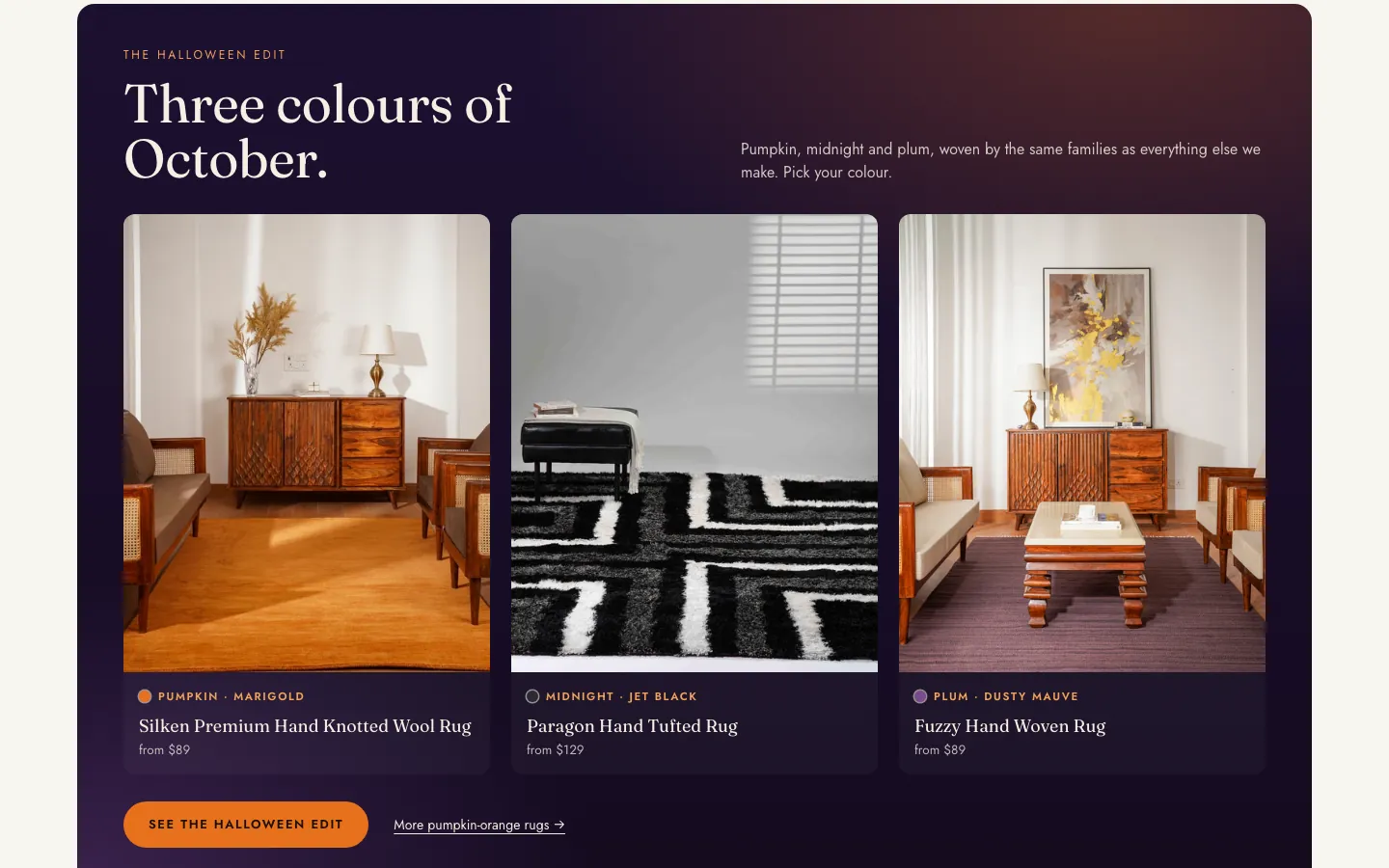
At the time of capture, the homepage was running a Halloween campaign. After a sale banner, a dark purple panel titled "Three colours of October" presents three rugs, one each for pumpkin, midnight and plum. Each card shows the rug styled in a living room, a color label, the rug name and a starting price, with buttons to see the full edit or more rugs in one color.
Grouping rugs by color gives shoppers an easy way into a large catalog, and the same section can be refreshed for each season.
03 / The project
Product cards designed for comparison
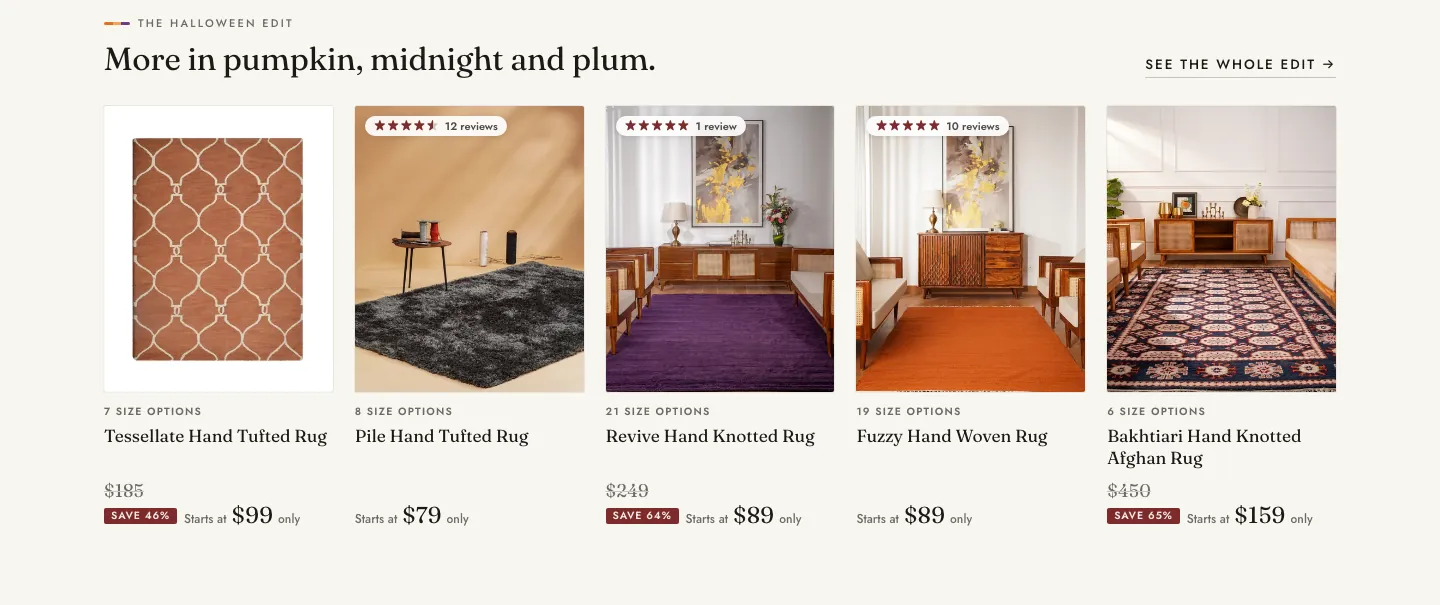
The campaign continues with "More in pumpkin, midnight and plum," a five-column product row with a link to see the whole edit. The same card design is reused for the Best Sellers and New Arrivals sections further down.
Each card shows a rug image, either as a flat product shot or styled in a room, and some carry a review badge. Under the image, the card lists how many size options the rug comes in, the rug name and its pricing, with a sale label where one applies. Showing the number of sizes up front matters for rugs, because the right size is often the first thing a shopper checks.
04 / The project
A room-based rug finder
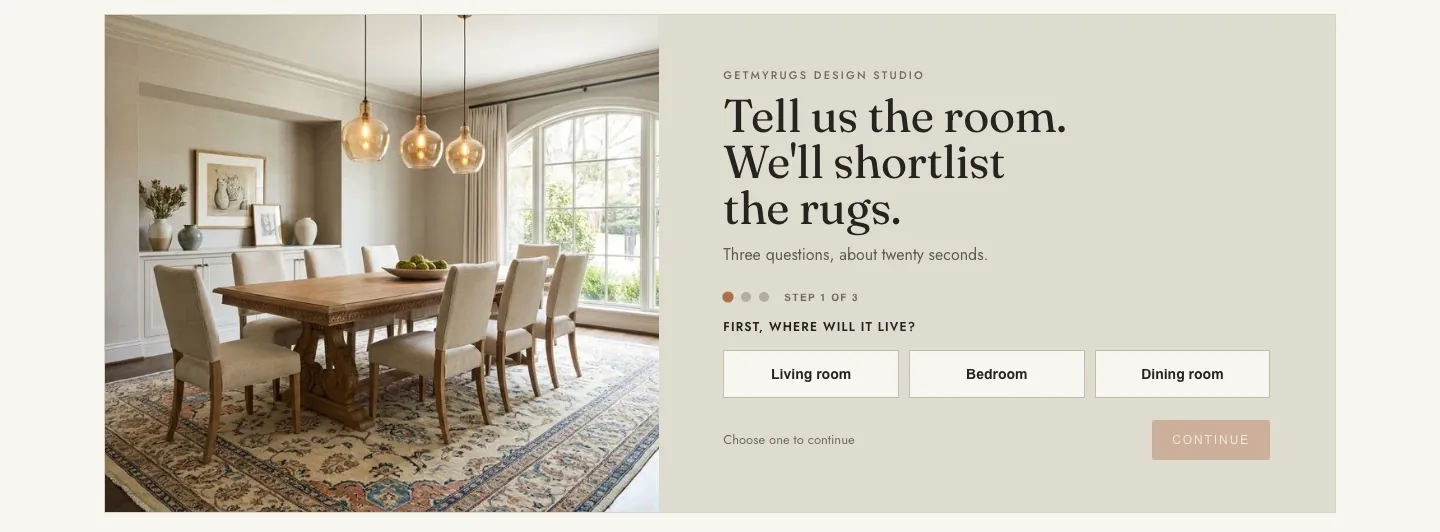
Between the best sellers and new arrivals, a "Design Studio" panel invites shoppers to "Tell us the room. We'll shortlist the rugs." It promises three questions and about twenty seconds.
The captured state shows step one of three, asking where the rug will live, with buttons for Living room, Bedroom and Dining room and a Continue button that activates after a choice. A dining room photo with a large patterned rug sits on the left. This guided flow gives undecided visitors a simpler starting point than a full set of filters.
05 / The project
Browsing by style
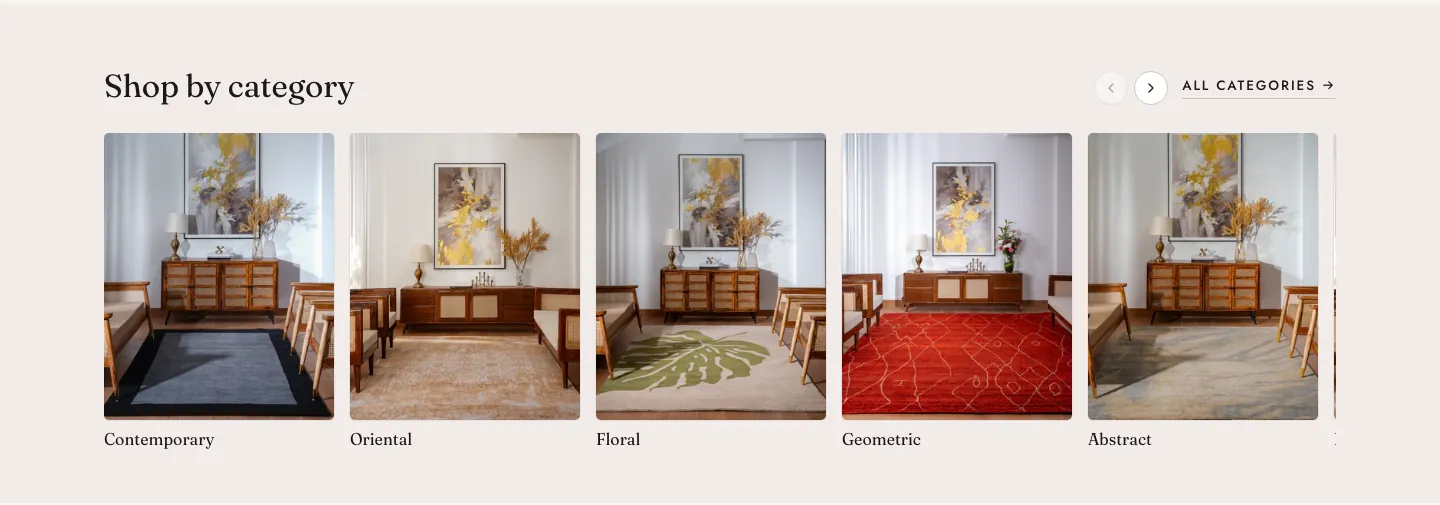
"Shop by category" is a horizontal carousel with arrow controls and an All Categories link. The visible tiles are Contemporary, Oriental, Floral, Geometric and Abstract.
Each tile uses the same living room scene with a different rug on the floor. Keeping the furniture and lighting constant makes the style differences easy to compare at a glance, and it helps shoppers imagine each style in a real space.
06 / The project
Explaining how the rugs are made
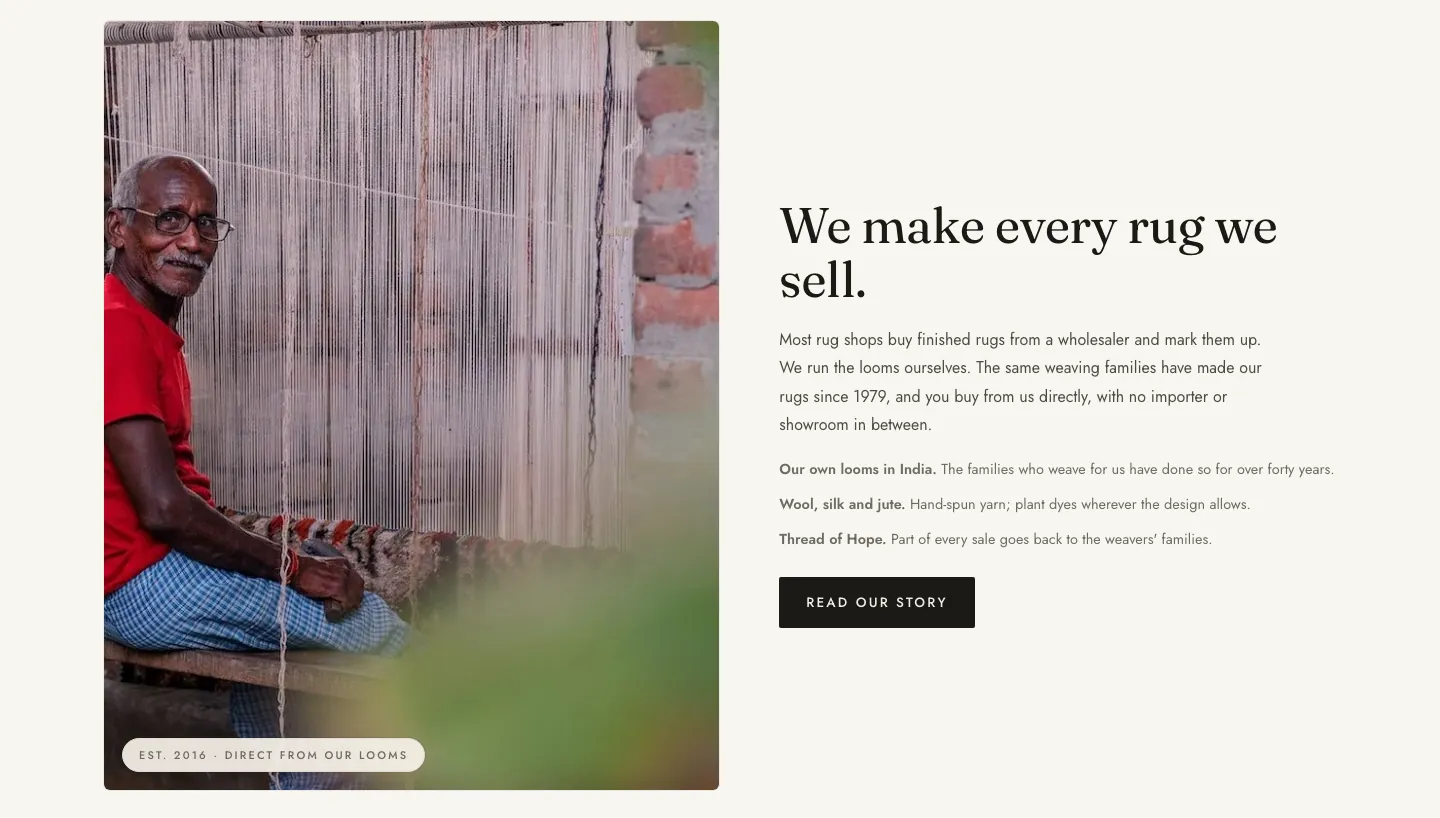
"We make every rug we sell" sets out the brand's story next to a photo of a weaver at a loom. The copy explains that the company runs its own looms rather than buying finished rugs from a wholesaler, and that customers buy directly without an importer or showroom in between.
Short bolded points follow on the company's own looms in India, the materials used (wool, silk and jute, with hand-spun yarn and plant dyes where the design allows) and its Thread of Hope program supporting weaving families. A Read Our Story button links to the full history. Lower on the page, a newsletter sign-up, an expandable FAQ and a longer brand text block answer common questions before the footer, which also links to the brand's mobile apps.
07 / The project
Why Shopify fits a rug business
Rugs come in many sizes, colors and patterns, so variants and filtering matter. Shopify's product variants, collections and storefront filtering support this kind of catalog, while hosted checkout, payments and order management cover the commerce essentials.
The live store builds on those foundations with merchandising that is easy to refresh: seasonal edits, best-seller and new-arrival rows, style carousels and content sections. For a brand selling directly from its own workshops, that leaves more time for products and storytelling.
For a brand planning a similar store, early work usually goes into the product data: consistent size options, color and pattern tags, and photography standards for both flat and room shots. Those decisions drive the filters, product cards and category carousels that shoppers rely on.
Technology used
Questions about this project
What did Ackrolix build for Get My Rugs?
Ackrolix's portfolio lists a Shopify eCommerce store for Get My Rugs, an online seller of handmade rugs and home decor.
How does the Get My Rugs store help shoppers choose a rug?
The live store offers navigation by size, color, pattern and category, seasonal color edits, product cards that show size options, a room-based finder and style categories.
Why is Shopify a good fit for rugs?
Rugs have many size and color variants. Shopify supports product variants, collections and filtering, along with hosted checkout and order management.
Can Ackrolix build a Shopify store for a home decor brand?
Yes. Ackrolix's portfolio includes several Shopify stores for home decor and retail brands, covering catalog structure, merchandising sections and content.
Prepared by Ackrolix Innovations from its development portfolio, pages 117, 118. Project profile based on the documented service scope. About the team.